
This public art project seeks to elevate how a community sees itself and how it is seen by others.
(Please scroll down.)
Este proyecto de arte público busca elevar la forma en que una comunidad se ve a sí misma y cómo es vista por los demás.
(Por favor, desplácese hacia abajo .)
Additional Project Images, Not Presently On Display at Peter Stephens Gallery
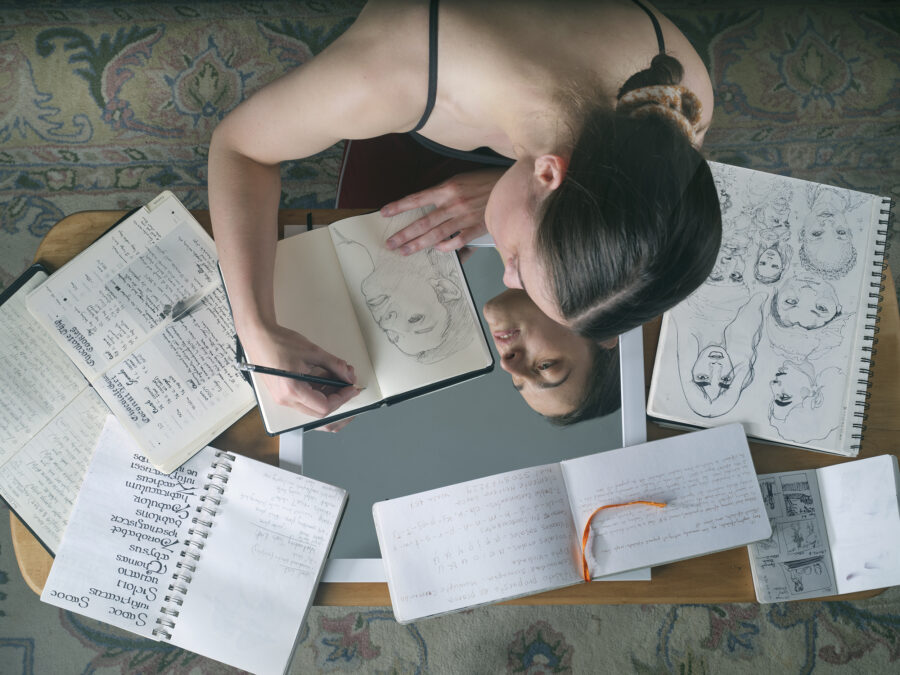
A.B. Williams
A.B. Williams with journals. Photographed August 5, 2025.
“I love languages,” says linguist and artist A.B. Williams. Now pivoting to fine art full-time, she is among a wave of artists moving to Fitchburg and serves on the board of Gallery Marquee. Her process constantly bridges art and linguistics.
A.B. constantly sketches and takes notes in her journals, filling pages with everything from pancake recipes to gestural portraits. These are bound volumes; she has many, and she takes along whichever fits best in her pocket or backpack that day. Fluent in English, she writes her dates in Chinese. She works on several concurrently and keeps completed journals for future reference.
A.B. has worked as a translator and trained corporate natural language processing models. “There are visual dialects, just as in verbal language,” A.B. observes. “AI algorithms now quietly sculpt our concept of beauty. But when a human draws a human, two people share a conversation. Paint has texture; watercolor bleeds. AI has no subject, artist, or physical medium—it only offers a digital ‘best guess.’”
For a recent exhibition at Gallery Marquee, A.B. displayed her live figure drawings alongside AI renderings generated from text prompts of the same subjects. Placing human and synthetic artwork side by side exposed pronounced deviations in how a subject is depicted – and how we perceive them. AI easily seduces us in isolation. But paired directly with a human original, we see how synthetic clones can also affect our values and expectations.
A.B. Williams
A.B. Williams con sus cuadernos. Fotografiada el 5 de agosto de 2025.
Me encantan los idiomas», afirma la lingüista y artista A.B. Williams. Dedicada ahora por completo a las bellas artes, forma parte de una ola de artistas que se están mudando a Fitchburg y es miembro de la junta directiva de Gallery Marquee. Su proceso creativo tiende continuamente puentes entre el arte y la lingüística.
A.B. hace bocetos y toma notas constantemente en sus cuadernos, llenando páginas con todo tipo de contenidos, desde recetas de panqueques hasta retratos gestuales. Son volúmenes encuadernados; tiene muchos, y lleva consigo el que mejor se adapte a su bolsillo o mochila ese día. Con un dominio fluido del inglés, escribe las fechas en chino. Trabaja en varios a la vez y conserva los cuadernos terminados para futuras consultas.
A.B. ha trabajado como traductora y ha entrenado modelos corporativos de procesamiento del lenguaje natural. «Existen dialectos visuales, igual que en el lenguaje verbal», observa A.B. «Los algoritmos de IA ahora esculpen silenciosamente nuestro concepto de belleza. Pero cuando un ser humano dibuja a otro, dos personas comparten una conversación. La pintura tiene textura; la acuarela se expande. La IA no tiene sujeto, artista ni soporte físico; solo ofrece una “conjetura digital aproximada”».
Para una exposición reciente en Gallery Marquee, A.B. exhibió sus dibujos del natural junto a representaciones generadas por IA a partir de descripciones textuales de los mismos modelos. Situar las obras humanas y sintéticas frente a frente dejó al descubierto marcadas divergencias en la forma de representar a un sujeto y en cómo lo percibimos. De manera aislada, la IA nos seduce con facilidad. Pero al compararla directamente con un original humano, vemos cómo los clones sintéticos también pueden transformar nuestros valores y expectativas.
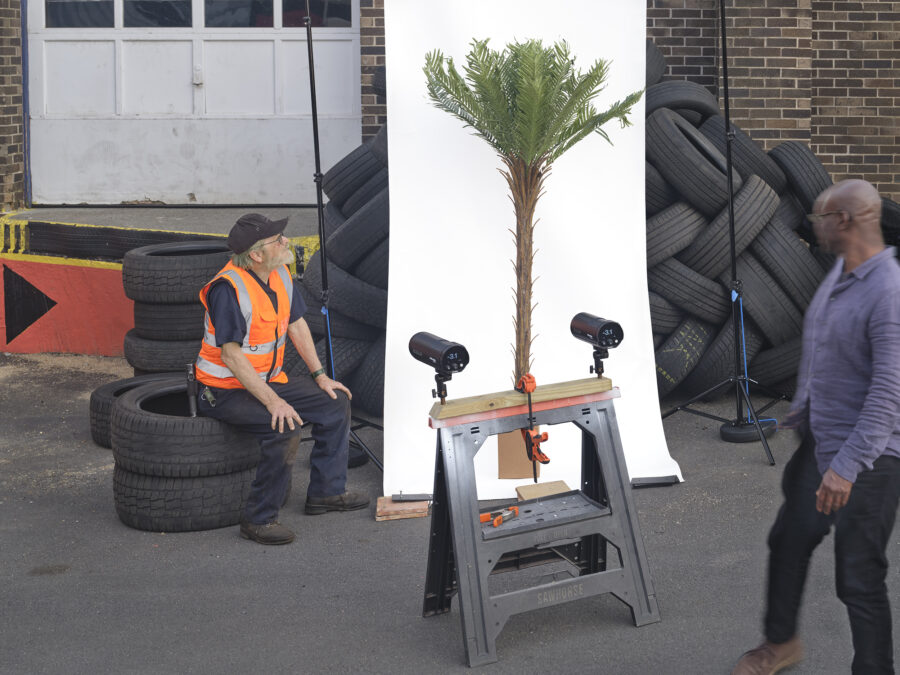
Hal Smith
Mechanic, Creative Problem Solver. Photographed April 30, 2025.
Hal Smith is a semi-retired mechanic. He hires out his time and works on problem cars that other mechanics prefer to avoid. As a teenager, a repertory theater opened just a short walk from his family farm. For Hal, engaging with this theater was a formative experience. “I met people from all walks of life and wanted to be part of their community. But I wasn’t an actor.” So Hal started working backstage as part of the production crew. He utilized his skills and imagination to construct, manage, and repair whatever needed to be done. Theatrical production became his passion. For one show, South Pacific, “… they needed to create the illusion of a Jeep rolling up behind a screen onto which they would project a film. That was easy. I took a sawhorse, put casters on it, and bolted two plow lights onto the sawhorse; I had a battery there and a switch. I turned the lights on, moved it around, and we had a Jeep!” With a short laugh, he adds, “Backstage is where the magic happens.” Six decades later, Hal Smith is still at it, now supporting Fitchburg’s two theater groups. “It’s not that I love community theater. It’s that I love the community of community theater.”
Hal Smith
Mecánico, solucionador creativo de problemas. Fotografiado el 30 de abril de 2025.
Hal Smith es un mecánico semi-retirado. Ofrece sus servicios de forma independiente y trabaja en aquellos «autos problemáticos» que otros mecánicos prefieren evitar.
Durante su adolescencia, abrió un teatro de repertorio a pocos pasos de la granja familiar. Para Hal, involucrarse con este teatro fue una experiencia formativa. «Conocí a personas de todos los ámbitos y quise formar parte de su comunidad. Pero yo no era actor». Así que Hal comenzó a trabajar entre bastidores como parte del equipo de producción. Utilizó su destreza e imaginación para construir, gestionar y reparar todo lo que hiciera falta. La producción teatral se convirtió en su pasión.
Para una puesta en escena, South Pacific, «… necesitaban crear la ilusión de un Jeep acercándose detrás de una pantalla sobre la que iban a proyectar una película. Fue fácil. Tomé un caballete de carpintero, le puse ruedas y le atornillé dos luces de arado; le puse una batería y un interruptor. Encendí las luces, lo moví de un lado a otro, ¡y ya teníamos un Jeep!». Con una risa breve, añade: «Detrás del escenario es donde ocurre la magia».
Seis décadas después, Hal Smith sigue al pie del cañón, apoyando ahora a los dos grupos de teatro de Fitchburg. «No es que me encante el teatro comunitario. Es que me encanta la comunidad que se crea en el teatro comunitario».
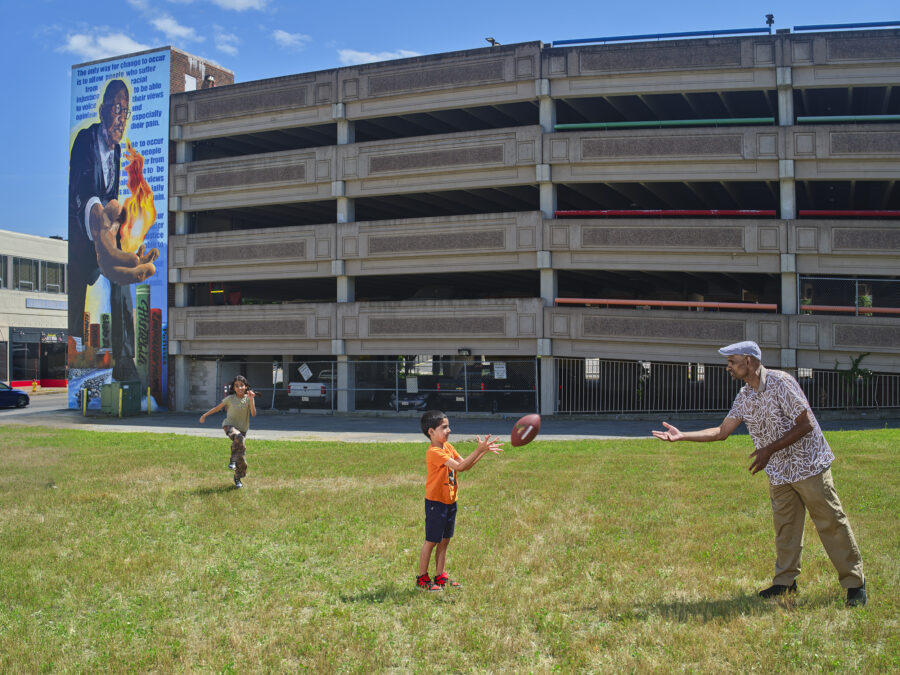
Furqan Mehmud
Furqan Mehmud carries on Adrian L. Ford’s legacy. Photographed June 29, 2026.
Furqan Mehmud is the President of the Ahmadiyya Muslim Community Center, located on Main Street. “Love for all and hatred for none.” So says the sign above the Center’s door. “I am not a local Imam,” Furqan clarifies, “although I do lead Friday prayers and provide some spiritual counseling.” “Furqan’s parents arrived in Fitchburg in 1981, ten years after another man dared to make history. Adrian L. Ford, 23 years old in 1971, was elected President of Three Pyramids, Inc. Three Pyramids promotes equal opportunity, personal responsibility, and social justice by empowering people of color, women, children, and families. Adrian, a Fitchburg resident, went on to become a legendary civil rights and community activist. A five-story mural painted in 2022, one block west of the Ahmadiyya Center, posthumously honors his work. In that mural, Adrian Ford holds the spirit of change in his hand – and passes it on to us. “My dad was involved with Three Pyramids,” Furqan says, “and I received training there.” There is considerable overlap in the concerns of our two organizations.” Not surprisingly, “Today, I am on their executive board.” Adrian Ford’s legacy burns bright in Furqan Mehmud. Islam informs his values but does not constrain his vision. Furqan’s heritage and beliefs do not make him ‘less’ American; they exemplify what it means to be American. Furqan Mehmud is but one example of how diversity has made the United States of America a healthier and stronger nation.
FurqanMehmud
Furqan Mehmud continúa el legado de Adrian L. Ford. Fotografiado el 29 de junio de 2026.
Furqan es el presidente del Centro de la Comunidad Musulmana Ahmadía, ubicado en Main Street. «Amor para todos y odio hacia nadie». Así dice el letrero sobre la puerta del Centro. «No soy un imán local», aclara Furqan, «aunque dirijo las oraciones de los viernes y ofrezco algo de orientación espiritual». Los padres de Furqan llegaron a Fitchburg en 1981, diez años después de que otro hombre se atreviera a hacer historia. Adrian L. Ford, de 23 años en 1971, fue elegido presidente de Three Pyramids, Inc. Three Pyramids promueve la igualdad de oportunidades, la responsabilidad personal y la justicia social al empoderar a personas de color, mujeres, niños y familias. Adrian, residente de Fitchburg, se convirtió en un legendario activista comunitario y defensor de los derechos civiles. Un mural de cinco pisos pintado en 2022, una cuadra al oeste del Centro Ahmadía, rinde homenaje a su labor de manera póstuma. En ese mural, Adrian Ford sostiene el espíritu del cambio en sus manos y nos lo transmite. «Mi padre colaboraba con Three Pyramids», dice Furqan, «y yo me formé allí. Existe una notable afinidad entre las inquietudes de nuestras dos organizaciones». No es de extrañar que «hoy en día forme parte de su junta directiva». El legado de Adrian Ford brilla con fuerza en Furqan Mehmud. El islam fundamenta sus valores, pero no restringe su visión. La herencia y las creencias de Furqan no lo hacen «menos» estadounidense; ejemplifican lo que significa ser estadounidense. Furqan Mehmud es solo un ejemplo de cómo la diversidad ha hecho de los Estados Unidos de América una nación más sana y más fuerte.
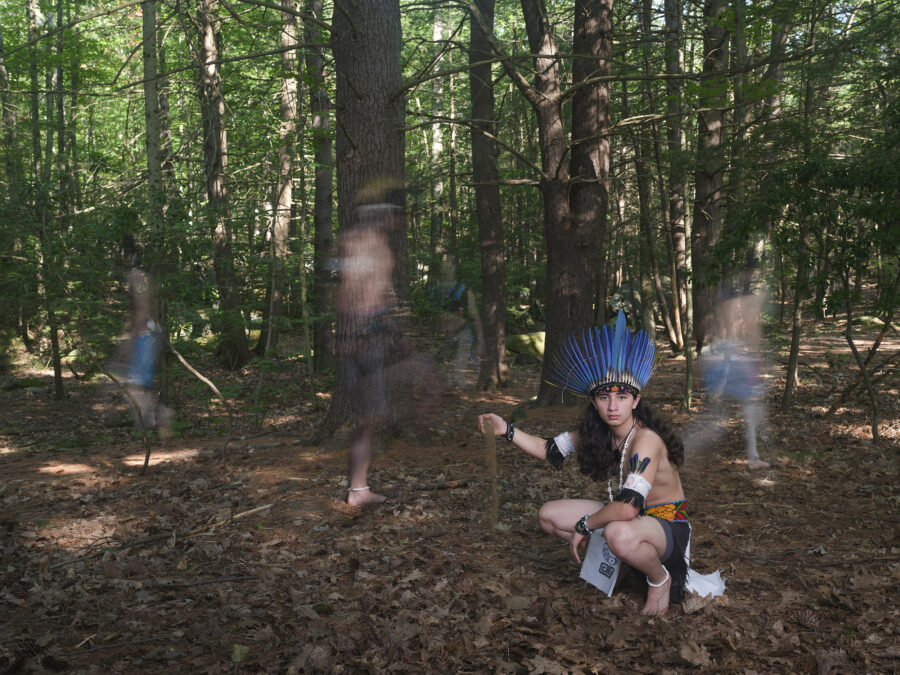
Diego Barahona
Indigenous Peoples Rights Activist. Photographed July 29, 2025.
What makes a young man stand tall and walk with the self-confidence of a prince? For Diego Barahona, 16 at the time of this writing, it is his heritage. Born to a Caribbean mother and a Central American father, he is particularly proud of his indigenous roots. His ancestors are the Taino and Nahua peoples. “I want to rekindle what we had, or what we lost, 500 years ago,” he says. His awakening at the age of 13 came through Chali’naru, an activist aunt who introduced him to Taino culture and taught him Taino dances. The past stepped into his present when she introduced him to tribal elders. Diego discovered a world whose presence he had sensed but never seen. “The Taino were a peaceful people. From 1493 onwards, starting with Christopher Columbus and continuing with the Spaniards, the Taino were subjected to enslavement, murder, and fatal diseases.” Nearly extinguished by 1550, those that survived did so by fleeing into the mountains. They had good reason to become invisible. Guaribono Nakan is a movement Diego founded and spearheads, raising awareness of the presence and rights of indigenous people. “The name means Warriors of Balance. We promote equity and mutual respect among all cultures.” Diego delivers his message through performance. Attired in a regalia of feathers, he speaks to gatherings ranging from civic meetings to high school classrooms, honoring the land and cultures associated with the very spot where the group has convened. And then he dances. “I want people to know that indigenous people are not extinct,” Diego says. “We are still here.” Diego Barahona ensures his people are no longer invisible.
Diego Barahona
Activista por los derechos de los pueblos indígenas. Fotografiado el 29 de julio de 2025.
¿Qué hace que un joven camine erguido y con la seguridad de un príncipe? Para Diego Barahona, de 16 años al momento de escribir estas líneas, es su herencia cultural. Hijo de madre caribeña y padre centroamericano, se siente especialmente orgulloso de sus raíces indígenas. Sus ancestros pertenecen a los pueblos taíno y nahua. «Quiero reavivar lo que teníamos, o lo que perdimos, hace 500 años», afirma. Su despertar a los 13 años llegó a través de Chali’naru, una tía activista que le dio a conocer la cultura taína y le enseñó sus danzas tradicionales. El pasado se hizo presente cuando ella lo presentó a los ancianos de la tribu. Diego descubrió un mundo cuya presencia había intuido pero nunca visto. «Los taínos eran un pueblo pacífico. A partir de 1493, comenzando con Cristóbal Colón y continuando con los españoles, los taínos fueron sometidos a la esclavitud, el asesinato y enfermedades mortales». Prácticamente extinguidos para 1550, los que sobrevivieron lo lograron huyendo hacia las montañas. Tenían buenas razones para volverse invisibles. Guaribono Nakan es un movimiento que Diego fundó y lidera, con el fin de crear conciencia sobre la presencia y los derechos de los pueblos originarios. «El nombre significa Guerreros del Equilibrio. Promovemos la equidad y el respeto mutuo entre todas las culturas». Diego transmite su mensaje a través de expresiones artísticas. Ataviado con su indumentaria tradicional de plumas, se dirige a audiencias que van desde reuniones cívicas hasta aulas de secundaria, rindiendo homenaje a la tierra y a las culturas ligadas al lugar exacto donde se han congregado. Y luego, danza. «Quiero que la gente sepa que los pueblos indígenas no están extintos», dice Diego. «Todavía estamos aquí». Diego Barahona se asegura de que su pueblo nunca más sea invisible.
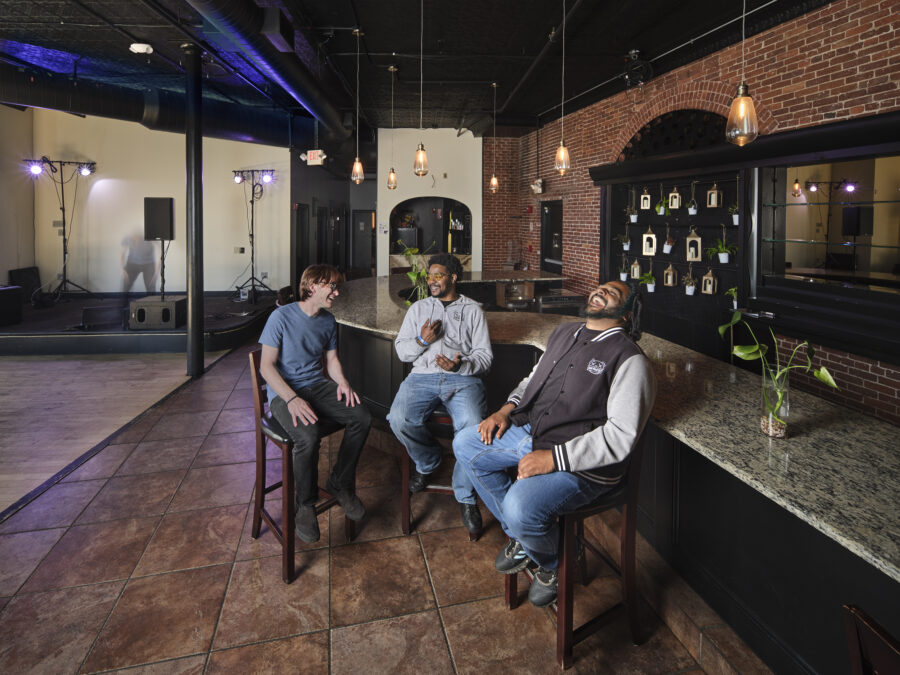
Coff33 Corp
Founders Merrick Henry, Derek Craig, and Joe Murchison. Photographed September 21, 2025.
I underestimated Derek Craig when I first met and interviewed him in 2024. Not because I projected limitations upon his potential, but because I was looking for a creative individual. I found him to be one. My problem was that I failed to see the larger picture. Derek is also a powerful social catalyst. Along with Joe Murchison and Merrick Henry, co-founders of Coff33 Corp, the three are making a significant impact on the culture and economy of North Central Massachusetts. This is not an overstatement. Coff33 (pronounced “coffee”) was born when the three set out to unify the independent efforts of 33 small businesses, nonprofits, creatives, and entrepreneurs who were trying to make Fitchburg a better place. Coff33 Corp is a parent organization with four Divisions: Young Coff33 Productions, Fitchburg Creative, Coff33 Network, and now Canvas. Canvas is their new 3,860-square-foot venue, featuring a stage and bar, with a capacity of 211 guests. Their overarching mission is to inclusively “cultivate creativity, innovation, and community engagement” through art and collaboration. They do this at all levels, from nurturing musicians to producing original music to staging concerts and community events. Their Dream It Create It program distributes local grants up to $15,000. The Annual River City Rhythm & Rock Fest draws an estimated 3,000 people. Derek may be the visionary, but the three agree that not one of them could have done this alone.
Coff33 Corp
Los fundadores Merrick Henry, Derek Craig y Joe Murchison. Fotografiado el 21 de septiembre de 2025.
Subestimé a Derek Craig cuando lo conocí y lo entrevisté por primera vez en 2024. No porque proyectara limitaciones sobre su potencial, sino porque estaba buscando a una persona creativa. Y descubrí que lo era. Mi problema fue que no logré ver el panorama completo. Derek es también un poderoso catalizador social. Junto a Joe Murchison y Merrick Henry, cofundadores de Coff33 Corp, los tres están generando un impacto significativo en la cultura y la economía del centro-norte de Massachusetts. No es una exageración. Coff33 (pronunciado «coffee») nació cuando los tres se propusieron unificar los esfuerzos independientes de 33 pequeñas empresas, organizaciones sin fines de lucro, creativos y emprendedores que intentaban hacer de Fitchburg un lugar mejor. Coff33 Corp es una organización matriz con cuatro divisiones: Young Coff33 Productions, Fitchburg Creative, Coff33 Network y, ahora, Canvas. Canvas es su nuevo espacio de 358 metros cuadrados (3.860 pies cuadrados), equipado con escenario y bar, y con una capacidad para 211 personas. Su misión primordial es «cultivar de manera inclusiva la creatividad, la innovación y la participación comunitaria» a través del arte y la colaboración. Hacen esto en todos los niveles: desde apoyar el desarrollo de músicos y producir música original, hasta organizar conciertos y eventos comunitarios. Su programa Dream It Create It distribuye subvenciones locales de hasta 15.000 dólares. El festival anual River City Rhythm & Rock Fest atrae a unas 3.000 personas. Puede que Derek sea el visionario, pero los tres coinciden en que ninguno de ellos podría haber logrado esto por su cuenta.
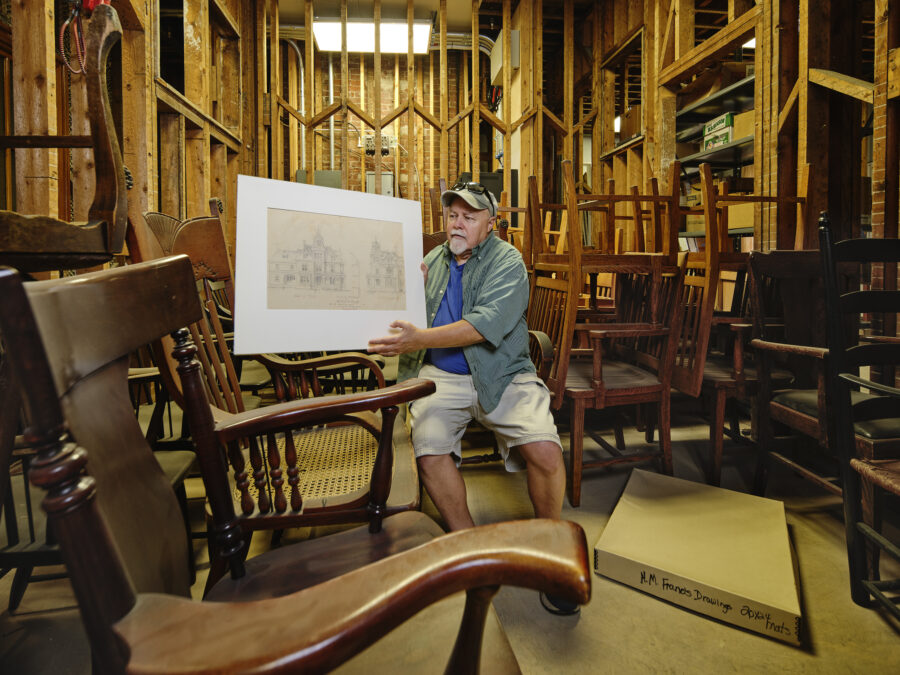
Bill Chittick
Bill Chittick with H.M. Francis Drawing at The Phoenix Building. Photographed September 24, 2025.
Bill Chittick startled me with his recollections of the 1977 architectural survey he performed. Among them: the elegant butler’s pantry in my house on Atlantic Avenue. Bill was visiting Fitchburg to check on the status of the H.M. Francis drawings. Henry Martyn Francis (1836-1908) was Fitchburg’s preeminent architect. His firm designed dozens of schools, churches, libraries, public and commercial buildings, as well as hundreds of residences throughout New England. When H.M. Francis & Sons closed in 1943, H.M.’s papers were lost. Then, in 1977, following a tip and armed with an ice pick, Bill Chittick and Frank Garretson arrived at a Lunenburg barn. They smashed icicles to pry open a door, shimmied through the narrow opening, and discovered the contents of H.M. Francis & Sons’ last office. Hundreds of drawings were scattered inside, all in pristine condition. One dated back to 1860. It was a momentous find, “not unlike the discovery of King Tut’s tomb,” according to Bill. The two made an impromptu inventory before the drawings’ storage at the Fitchburg Historical Society. There, aside from one brief display of selected works, they have quietly resided. Now, nearly 50 years after their discovery, Bill is returning to inventory, organize, and catalog the drawings. “I know probably 90% of the context for each drawing. I remember buildings that are no longer there. But I’ve got to get the information out of my head and into filing cabinets. You can call it history, but I think ‘Fitchburg’s story’ is more appropriate.”
Bill Chittick
Bill Chittick con un plano de H.M. Francis en el edificio Phoenix. Fotografiado el 24 de septiembre de 2025.
Bill Chittick me sorprendió con sus recuerdos del relevamiento arquitectónico que realizó en 1977. Entre ellos: la elegante antecocina de mi casa en Atlantic Avenue. Bill estaba de visita en Fitchburg para comprobar el estado de los planos de H.M. Francis. Henry Martyn Francis (1836-1908) fue el arquitecto más destacado de Fitchburg. Su firma diseñó docenas de escuelas, iglesias, bibliotecas, edificios públicos y comerciales, así como cientos de residencias por toda Nueva Inglaterra. Cuando H.M. Francis & Sons cerró en 1943, los documentos de H.M. se perdieron. Luego, en 1977, siguiendo una pista y armados con un picahielos, Bill Chittick y Frank Garretson llegaron a un granero en Lunenburg. Rompieron carámbanos de hielo para forzar una puerta, se deslizaron por la estrecha abertura y descubrieron el contenido de la última oficina de H.M. Francis & Sons. Cientos de dibujos y planos estaban dispersos en el interior, todos en perfectas condiciones. Uno de ellos databa de 1860. Fue un hallazgo trascendental, «no muy diferente al descubrimiento de la tumba del rey Tutankamón», según Bill. Ambos realizaron un inventario improvisado antes de que los planos fueran almacenados en la Sociedad Histórica de Fitchburg. Allí, salvo por una breve exhibición de obras seleccionadas, han permanecido en silencio. Ahora, casi 50 años después de su descubrimiento, Bill regresa para inventariar, organizar y catalogar los planos. «Conozco probablemente el 90% del contexto de cada plano. Recuerdo edificios que ya no existen. Pero tengo que sacar la información de mi cabeza y ponerla en archivadores. Se le puede llamar historia, pero creo que “la historia de Fitchburg” es más apropiado».
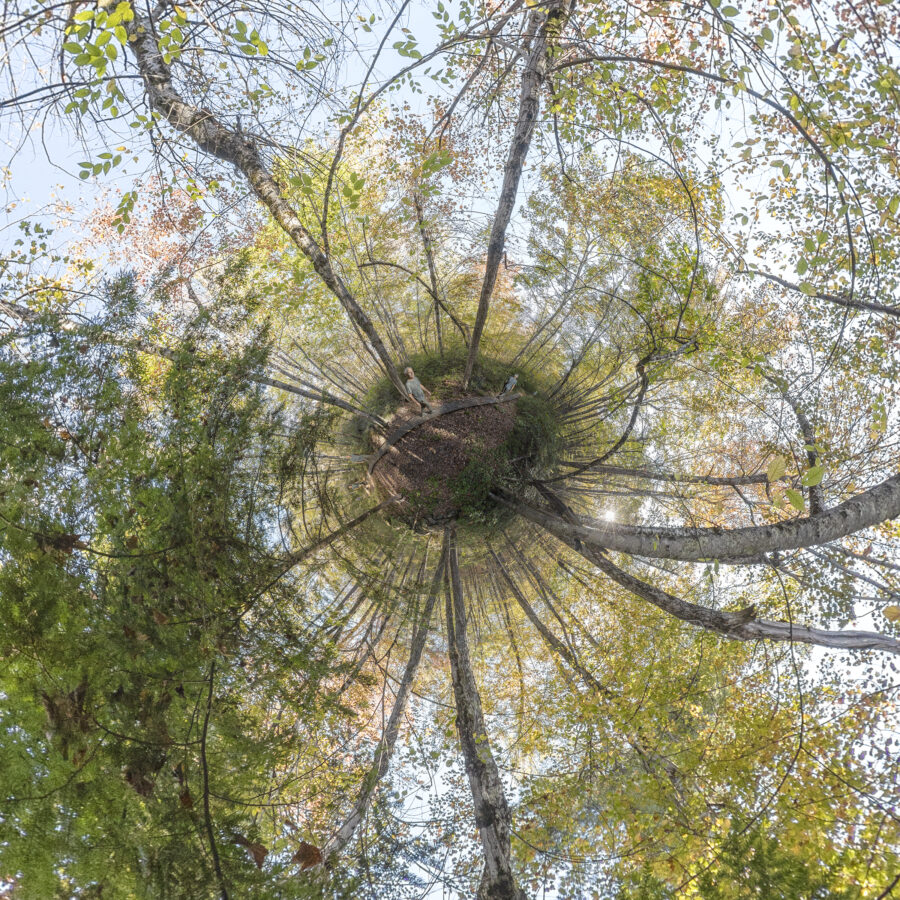
Ralph Baker
Ralph Baker, Soil Scientist, hikes a Fitchburg trail. Photographed October 6, 2025.
“I’m passionate about nature in its entirety.” Ralph is the President of the Nashua River Watershed Association and co-leads the Fitchburg Trail Stewards. Although much of the Nashua River watershed is in conservation, it is not fully protected. Logging is permitted, for example, with potentially devastating effects on soil compaction and biodiversity. “Given enough time, nature can heal itself. It’ll flourish if we leave it alone.” Ralph Baker is determined to help both things happen. He has created the first forever wild space in Fitchburg. A forever wild land status keeps management by people to a bare minimum. “The earth and its community of life are untrammeled by man, where man himself is a visitor who does not remain,” is how Congress defined wilderness in The Wilderness Act of 1964. Ralph donated an easement on a 20-acre parcel of land to the North County Land Trust (NCLT). Through a formal Conservation Restriction monitored by the NCLT, the land’s future development or commercialization will be prohibited, while an existing public trail will remain accessible for hiking and other non-intrusive visits. Nature is free to follow its course on this conservation reserve. This extraordinary gift follows another that Ralph made in 2017, when Fitchburg planned to log a 200-acre section in the Nashua’s watershed. He personally paid the city $50,000 to forego two timber harvestings. The city financially benefited more from Ralph’s gift than it would have profited from logging, and this first-step agreement can later be extended under similar terms. “Nature is a community we belong to,” Ralph Baker says, “not a commodity to exploit.”
Ralph Baker
Ralph Baker, edafólogo, recorre un sendero de Fitchburg. Fotografiado el 6 de octubre de 2025.
«Silvestre para siempre» (Forever Wild) es más que una frase romántica; define legalmente la tierra donde la naturaleza sigue su propio curso. Para Ralph Baker, edafólogo de Fitchburg, presidente de la Asociación de la Cuenca del Río Nashua y colíder de los Fitchburg Trail Stewards, la expresión resalta la distinción entre tierra conservada y tierra totalmente protegida.
La tierra conservada permite prácticas como la tala, que amenazan el suelo y la biodiversidad. Tras haber recorrido incontables senderos en la cuenca de 1.820 hectáreas (4.500 acres) del río Nashua, Ralph tiene pruebas que respaldan su postura. «Los muros de piedra que cruzan Nueva Inglaterra delimitan linderos de propiedad donde se tomaron diferentes decisiones de gestión de tierras, y las consecuencias son claramente visibles», comenta. «Con el tiempo suficiente, la naturaleza puede sanar por sí misma. Prosperará si la dejamos en paz». Ese es el principio esencial de un espacio silvestre protegido.
Para impulsar el primer espacio Forever Wild de Fitchburg, Ralph se asoció con North County Land Trust (NCLT). El NCLT exige que estas tierras estén protegidas permanentemente del desarrollo urbano o del manejo de la vegetación, reforzando el paso de tierra conservada a tierra plenamente protegida, «donde la tierra y su comunidad biótica no están dominadas por el ser humano, donde el hombre mismo es un visitante que no permanece», tal como se establece en la Ley de Áreas Silvestres (Wilderness Act) del Congreso de los EE. UU. de 1964.
Ralph estableció la reserva Forever Wild de Fitchburg al donar una Restricción de Conservación sobre una parcela de 8 hectáreas (20 acres) al NCLT, impidiendo la urbanización y manteniendo abiertos los senderos públicos. Dicho esfuerzo siguió a su donación de 2017 a la ciudad, mediante la cual pagó 50.000 dólares a Fitchburg para detener por 30 años la tala planificada en un bosque de cuenca de 80 hectáreas (200 acres), protegiendo el bosque y compensando a la ciudad con una cantidad superior a la que habría obtenido por la madera cosechada.
«La naturaleza es una comunidad a la que pertenecemos», afirma Ralph Baker, «no una mercancía para explotar».
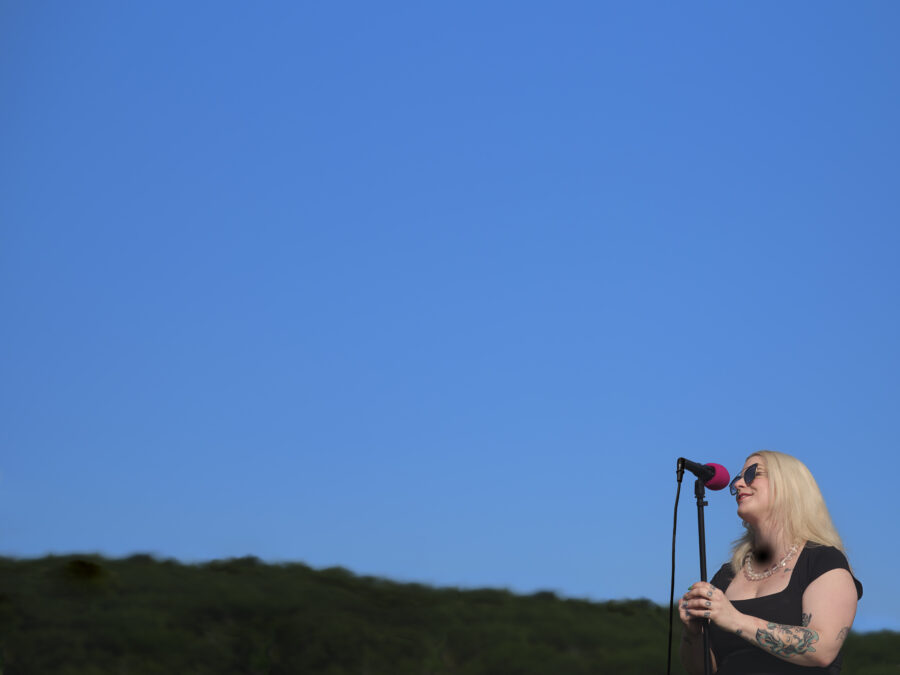
Laura DiCaronimo
Founder, The Openest Mic. Photographed June 11, 2025.
Laura DiCaronimo founded The Openest Mic, where anyone can get five minutes of airtime. “I don’t care if you go up there and just hum under your breath,” she says. “You’re not coming here to impress … when somebody really cares about what they’re doing, we know that’s bone deep.” The Openest Mic gatherings are super affirming and super fun. “It’s not that we don’t have standards, but that we’re unpretentious.” Some people share their best work; others test early drafts, and still others are simply playful. The show bounces from one venue to another, and the audience follows. “I usually give a talk at the beginning about no hate speech. I tell them: If you hear something offensive, first let it percolate. There might be something you need to learn about yourself.’ I do have an air horn, just in case, but I’ve never had to use it.” These are turbulent times. Strife has frayed our social fabric, if not yet torn it. The Openest Mike weaves multi-colored threads that bind our community, sewing pockets of love, joy, meaning, and resiliency.
Laura DiCaronimo
Fundadora de The Openest Mic. Fotografiada el 11 de junio de 2025.
Laura DiCaronimo fundó The Openest Mic, un espacio donde cualquiera puede tener cinco minutos en el escenario. «No me importa si subes allí y solo tarareas por lo bajo», dice. «No vienes aquí a impresionar… cuando a alguien realmente le apasiona lo que hace, sabemos que eso se siente hasta los huesos». Los encuentros de The Openest Mic son sumamente enriquecedores y muy divertidos. «No es que no tengamos estándares, sino que no tenemos pretensiones». Algunas personas comparten su mejor trabajo; otras prueban borradores iniciales y otras simplemente vienen a jugar y pasarla bien. El espectáculo va de un lugar a otro, y el público lo sigue fielmente. «Suelo dar una pequeña charla al principio sobre no permitir discursos de odio. Les digo: “Si escuchan algo que les ofenda, primero déjenlo procesar. Quizá haya algo que necesiten aprender sobre ustedes mismos”. Tengo una bocina de aire por si acaso, pero nunca he tenido que usarla». Vivimos tiempos turbulentos. Los conflictos han desgastado nuestro tejido social, si es que aún no lo han roto por completo. The Openest Mic teje hilos multicolores que unen a nuestra comunidad, bordando espacios de amor, alegría, significado y resiliencia.
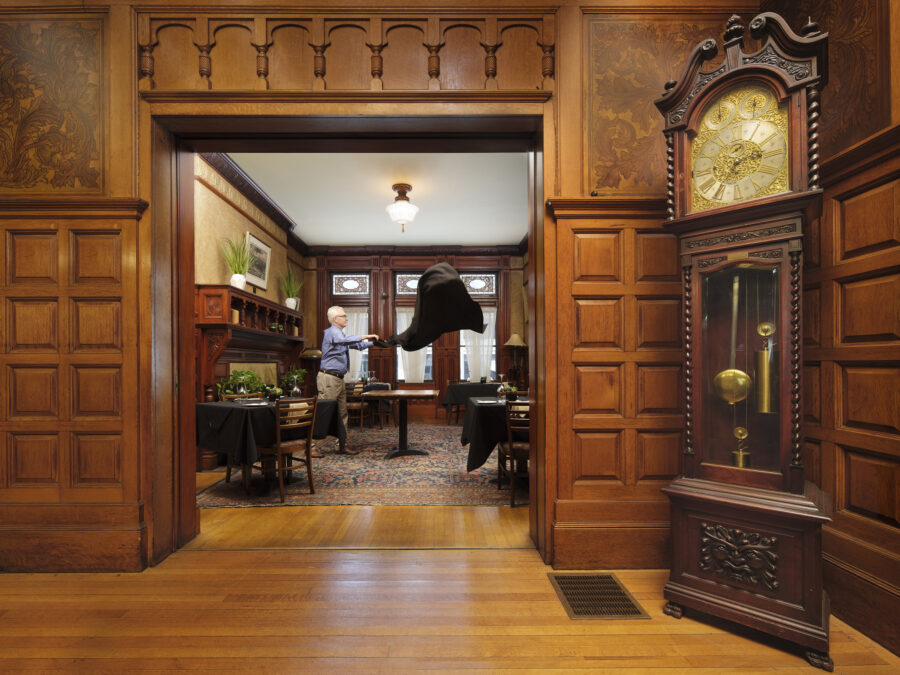
Steve Duvarney
Steve Duvarney unfurls a tablecloth at the Fay Club. Photographed March 27, 2024.
When Steve Duvarney’s grandfather opened his family jewelry store in 1970, his was the fifth jewelry store in downtown Fitchburg. Steve’s grandfather found clients through The Fay Club, a private dining association where community leaders networked with peers. The Fay Club had a storied tradition of hosting mill owners, bank presidents, doctors, and lawyers. Built in 1883, it was a testament to Fitchburg’s grandeur.
The Fay Club’s prosperity aligned with Fitchburg’s. As paper mills closed in the late 1900s, membership declined and the Club became increasingly less profitable. In 2015, all hope seemed lost. The Board prepared the building for sale.
Steve Duvarney has been a familiar face on Main Street since 1987 when he started working for his grandfather. (The family jewelry store is now his, at the other end of Main Street.) His bond with The Fay Club, its members, their culture, and the Club’s Victorian architecture runs deep. The thought of selling the building was unbearable to him.
Steve mobilized a handful of Club members to execute a desperate plan. Assuming the Club’s Presidency, Steve and his allies renegotiated bank loans, slashed membership fees, broadened their business model, and tapped volunteer labor. Quietly, anonymously, some in the group also reached into their pockets to cover inevitable shortfalls. The Club is now a regional magnet. It draws patrons from Groton, Concord, Worcester, and beyond. It successfully addressed capital expenditures and operating costs. It is well on the road to a self-sustained future. The Fay Club remains a private club, yet it wholeheartedly welcomes new members and guests.
Steve Duvarney continues to volunteer his time to the Club on a near-daily basis. His is a labor of love, driven by passion. He appreciates history but knows The Fay Club manifests more than tradition. It embodies long-lasting relationships. It is a place where friends are willing to step up when their community needs help.
Steve Duvarney
Steve Duvarney extiende un mantel en The Fay Club. Fotografiado el 27 de marzo de 2024.
Cuando el abuelo de Steve Duvarney abrió su joyería familiar en 1970, era la quinta joyería en el centro de Fitchburg. El abuelo de Steve conseguía clientes a través de The Fay Club, una asociación gastronómica privada donde los líderes comunitarios establecían contactos con sus pares. The Fay Club tenía una ilustre tradición de acoger a propietarios de fábricas, presidentes de bancos, médicos y abogados. Construido en 1883, era un testimonio de la grandeza de Fitchburg.
La prosperidad de The Fay Club fue de la mano con la de Fitchburg. A medida que las fábricas de papel cerraron a finales del siglo XX, el número de miembros disminuyó y el club se volvió cada vez menos rentable. En 2015, toda esperanza parecía perdida: la junta directiva preparó el edificio para su venta.
Steve Duvarney ha sido un rostro familiar en Main Street desde 1987, cuando comenzó a trabajar para su abuelo. (La joyería familiar ahora es suya y se encuentra en el otro extremo de Main Street). Su vínculo con The Fay Club, sus miembros, su cultura y la arquitectura victoriana del club es muy profundo. La idea de vender el edificio le resultaba insoportable.
Steve movilizó a un puñado de miembros del club para poner en marcha un plan desesperado. Al asumir la presidencia del club, Steve y sus aliados renegociaron préstamos bancarios, redujeron drásticamente las cuotas de afiliación, ampliaron su modelo de negocio y recurrieron al trabajo voluntario. De manera discreta y anónima, algunos integrantes del grupo también aportaron de su propio bolsillo para cubrir los déficits inevitables. Hoy, el club es un imán regional: atrae a clientes de Groton, Concord, Worcester y más allá. Logró resolver con éxito sus gastos de capital y costos operativos, y se encuentra encaminado hacia un futuro autosustentable. The Fay Club sigue siendo un club privado, pero recibe con entusiasmo y calidez a nuevos socios e invitados.
Steve Duvarney continúa dedicando su tiempo como voluntario en el club prácticamente a diario. La suya es una labor altruista, impulsada por la pasión. Aprecia la historia, pero sabe que The Fay Club manifiesta mucho más que tradición: encarna relaciones duraderas. Es un lugar donde los amigos están dispuestos a dar un paso al frente cuando su comunidad necesita ayuda.
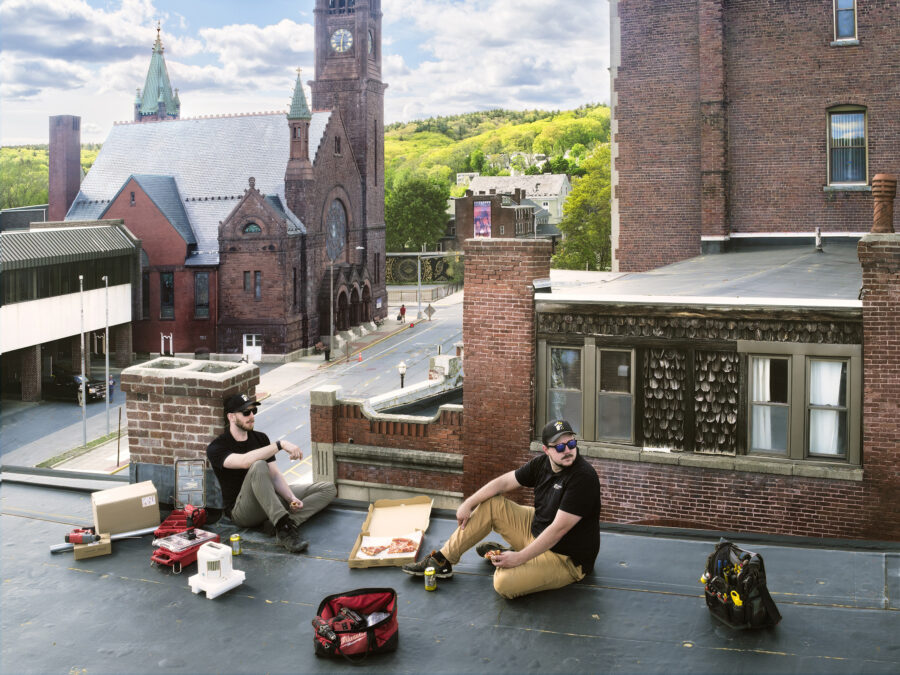
Tristan Taylor and Andrew DeChristopher
Andrew DeChristopher and Tristan Taylor with radio node on lunch break. Photographed May 13, 2024.
Tristan Taylor was outraged. In late 2020, as Covid lockdowns lifted, schoolchildren were forced to attend online classes, but many families couldn’t afford internet access. One mother with four kids faced a $180 monthly bill and had her service cut off. “Libraries were closed, schools couldn’t provide hotspots, and people were flocking to any place with public WiFi,” Tristan says. “That boiled my blood.”
Tristan, trained in Geographic Information Systems, was assigned by his employer to collaborate remotely with Andrew DeChristopher, a software engineer. The two, sharing outrage over profit-driven utility companies, decided to act. They drafted a business plan, met for the first time at a bank, and founded Fitchburg Fiber.
Fitchburg Fiber’s mission: affordable internet access. “This is the right thing to do,” Tristan says. With no revenue and fiber optic installation costs soaring to $1,000 per foot, the founders turned to wireless technology. They bought high-bandwidth radio links and installed them on rooftops, creating a dense mesh of coverage.
The next challenge: competing with giants like Verizon and Comcast. Spotting areas in Fitchburg that cable didn’t reach, they started there. Fitchburg Fiber now serves a one-mile by half-mile area downtown, funded by $200,000 from the founders’ own pockets.
Initially, Tristan and Andrew kept their full-time jobs, working nights and weekends for Fitchburg Fiber. Now Tristan works solely for the company, while Andrew supports it with a second job. Both handle everything from hardware installation to customer support.
Unlike competitors who raise prices after low introductory offers, Fitchburg Fiber locks its $40 monthly fee—forever. “We want to lower that price over time,” Andrew says. Tristan adds, “Our long-term goal is to build fiber for all of Fitchburg and eventually transition to a customer-owned cooperative. Fitchburg Fiber will be a self-sustaining public utility, free from profit motives.”
Tristan Taylor y Andrew DeChristopher
Andrew DeChristopher y Tristan Taylor con un nodo de radio durante la pausa del almuerzo. Fotografiado el 13 de mayo de 2024.
Tristan Taylor estaba indignado. A finales de 2020, cuando se levantaban los confinamientos por la COVID-19, los escolares se vieron obligados a asistir a clases virtuales, pero muchas familias no podían costear el acceso a internet. Una madre con cuatro hijos se enfrentó a una factura mensual de 180 dólares y le cortaron el servicio. «Las bibliotecas estaban cerradas, las escuelas no podían proporcionar puntos de acceso y la gente acudía en masa a cualquier lugar con wifi público», cuenta Tristan. «Eso me hizo hervir la sangre».
Tristan, especialista en Sistemas de Información Geográfica, fue asignado por su empleador para colaborar de forma remota con Andrew DeChristopher, un ingeniero de software. Ambos, compartiendo su indignación ante las empresas de servicios públicos impulsadas únicamente por el lucro, decidieron actuar. Redactaron un plan de negocios, se conocieron en persona por primera vez en un banco y fundaron Fitchburg Fiber.
La misión de Fitchburg Fiber: acceso a internet asequible. «Esto es lo correcto», afirma Tristan. Sin ingresos iniciales y con costos de instalación de fibra óptica que se disparaban a 1.000 dólares por pie, los fundadores recurrieron a la tecnología inalámbrica. Compraron enlaces de radio de gran ancho de banda y los instalaron en azoteas, creando una densa red de cobertura en malla.
El siguiente reto: competir contra gigantes como Verizon y Comcast. Al identificar zonas de Fitchburg a las que el cable no llegaba, comenzaron por allí. Fitchburg Fiber ahora brinda servicio a un área de una milla por media milla en el centro de la ciudad, financiada con 200.000 dólares salidos de los propios bolsillos de los fundadores.
Al principio, Tristan y Andrew mantuvieron sus empleos a tiempo completo, trabajando por las noches y los fines de semana en Fitchburg Fiber. Ahora, Tristan trabaja exclusivamente para la empresa, mientras que Andrew la respalda con un segundo empleo. Ambos se encargan de todo, desde la instalación del hardware hasta la atención al cliente.
A diferencia de los competidores que aumentan los precios tras ofertas introductorias bajas, Fitchburg Fiber congela su tarifa mensual de 40 dólares para siempre. «Queremos reducir ese precio con el tiempo», señala Andrew. Tristan añade: «Nuestro objetivo a largo plazo es llevar la fibra a todo Fitchburg y, con el tiempo, hacer la transición hacia una cooperativa propiedad de los propios clientes. Fitchburg Fiber será un servicio público autosustentable, libre de fines de lucro».
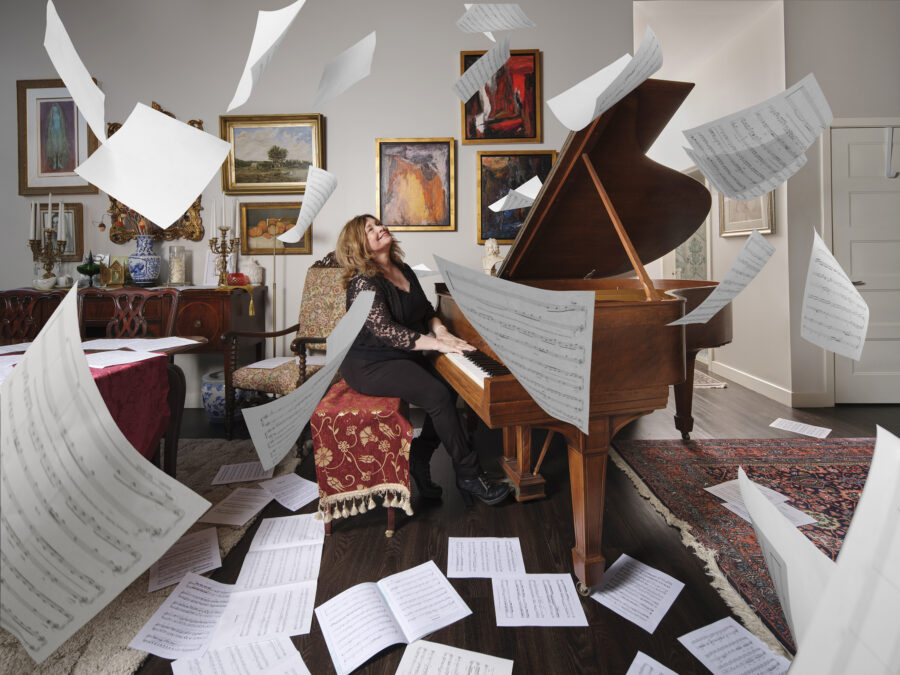
Jennifer L. Jones
Jennifer L. Jones at her Steinway in the Yarnworks. Photographed July 26, 2024.
“Music is a universal language,” says composer Jennifer L. Jones, seated at her Steinway piano in the elegantly restored mill building, The Yarnworks. Paintings, prints, drawings, and photographs fill her walls—or at least as high as a person can reach vertically. “Music is an expression of love. It heals, brings joy, and embodies a chain that pulls us together.”
Jennifer received her first piano lessons from a neighbor at age 9. Now, more than ever, she appreciates the gift. She studied at the Boston Conservatory of Music and became a music teacher. “I loved teaching music. That experience led me to become an advocate for high-quality arts education.” During this time, she stopped playing the piano for herself.
“When we moved to Fitchburg in 1988, I got involved with the community by giving private music lessons to neighborhood kids.” Lots of them came from low-income families. Fitchburg has diverse neighborhoods, and, in some cases, schoolchildren had to translate for their non-English speaking parents. “They loved music, just like everyone else.” When Jennifer became a music teacher in the public schools the following year, she realized that extracurricular challenges impaired these children’s academic achievement. She felt compelled to make a still more significant contribution.
Assuming the role of Director of Arts for the Fitchburg public schools, she championed after-school enrichment programs. “My primary goal was to provide access to arts education for all children during the school day and after school with the hope of closing the achievement gap for struggling learners in reading and math.” Jennifer opened after-school sites at each public school in Fitchburg. At one point, we had 500 kids participating at ten sites. Our program wasn’t about more academics; it was about enrichment. We would integrate music, art, puppetry, and theater into their experience. And it made a difference. We were able to close the achievement gap for more than 85% of participating children across the district.”
After retiring in 2016, Jennifer returned to her first love, the piano. This time, her approach was different. She didn’t want just to play music; she wanted to create it. She became a composer. She has since struck her creative stride with an impressive collection of original pieces. “I am back to practicing the piano and listening to the music of emerging artists and composers. It is a thrill to have my music streamed worldwide!”
“The piano can kindle feelings of peace and joy,” Jennifer L. Jones says. “I just finished a composition called ‘Castles in the Sky.’ I love the image of castles floating above the clouds, drifting, slipping in and out of the mist. It’s another world. It seems so distant and yet so familiar. That’s where music can take you.”
Jennifer L. Jones
Jennifer L. Jones ante su Steinway en The Yarnworks. Fotografiada el 26 de julio de 2024.
«La música es un lenguaje universal», dice la compositora Jennifer L. Jones, sentada ante su piano Steinway en el edificio industrial elegantemente restaurado, The Yarnworks. Pinturas, grabados, dibujos y fotografías cubren sus paredes, al menos hasta donde alcanza verticalmente una persona. «La música es una expresión de amor. Sana, brinda alegría y encarna una cadena que nos une a todos».
Jennifer recibió sus primeras clases de piano de una vecina a los 9 años. Ahora, más que nunca, valora ese regalo. Estudió en el Conservatorio de Música de Boston y se convirtió en profesora de música. «Me encantaba enseñar música. Esa experiencia me llevó a convertirme en una defensora de la educación artística de alta calidad». Durante ese tiempo, dejó de tocar el piano para sí misma.
«Cuando nos mudamos a Fitchburg en 1988, me involucré con la comunidad dando clases particulares de música a los niños del vecindario». Muchos de ellos provenían de familias de bajos recursos. Fitchburg cuenta con vecindarios diversos y, en algunos casos, los niños en edad escolar tenían que traducir para sus padres que no hablaban inglés. «Les encantaba la música, igual que a cualquier otra persona». Al año siguiente, cuando Jennifer se convirtió en maestra de música en las escuelas públicas, comprendió que las dificultades extracurriculares afectaban el rendimiento académico de estos niños. Se sintió motivada a hacer una contribución aún más significativa.
Al asumir el cargo de Directora de Artes de las escuelas públicas de Fitchburg, impulsó programas de enriquecimiento extraescolar. «Mi objetivo principal era brindar acceso a la educación artística a todos los niños durante la jornada escolar y después de clases, con la esperanza de cerrar la brecha de rendimiento en lectura y matemáticas para los estudiantes con dificultades». Jennifer abrió sedes extraescolares en cada escuela pública de Fitchburg. «En un momento dado, teníamos a 500 niños participando en diez sedes. Nuestro programa no se trataba de añadir más carga académica; se trataba de enriquecimiento. Integrábamos música, arte, títeres y teatro en su experiencia. Y marcó la diferencia: logramos cerrar la brecha de rendimiento en más del 85% de los niños participantes en todo el distrito».
Tras jubilarse en 2016, Jennifer regresó a su primer amor: el piano. Esta vez, su enfoque fue distinto. No quería limitarse a interpretar música; quería crearla. Se convirtió en compositora. Desde entonces, ha encontrado su plenitud creativa con una impresionante colección de obras originales. «He vuelto a practicar el piano y a escuchar la música de artistas y compositores emergentes. ¡Es una emoción enorme que mi música se escuche en plataformas digitales de todo el mundo!».
«El piano puede despertar sentimientos de paz y alegría», dice Jennifer L. Jones. «Acabo de terminar una composición titulada Castles in the Sky (Castillos en el cielo). Me encanta la imagen de castillos flotando sobre las nubes, a la deriva, apareciendo y desapareciendo entre la niebla. Es otro mundo. Parece tan lejano y, a la vez, tan familiar. Ahí es donde la música te puede llevar».
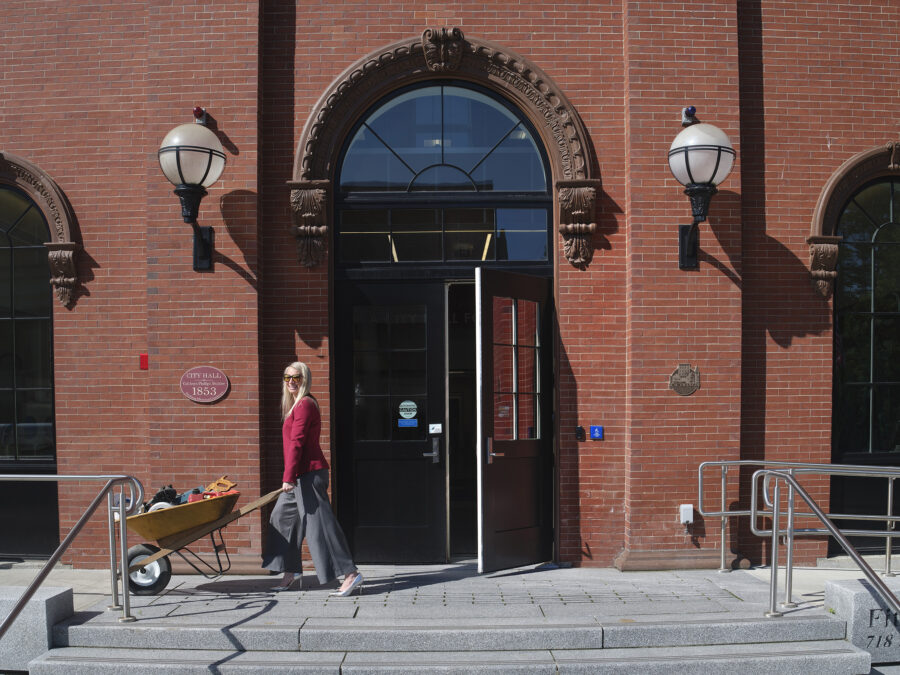
Mayor Sam Squailia
Mayor Sam Squalia working hard in high heels at City Hall. Photographed May 31, 2024
It was 9:20 PM when her email came in. Mayor Sam was working late again. Sam Squailia was confirming a follow-up interview to a portrait I had taken of her wearing high heels – and pushing a wheelbarrow. I had been hesitant to propose that photo concept to her; I hardly knew her at the time. What I did know was the impression she had made on me: hers is a can-do spirit brimming with confidence, agency, and a sunlit smile. We would meet in her office.
“You seem to attend every event in Fitchburg, manage an administration, and you’re a mom. What is your typical day like?” I ask.
“I get here around seven after I drop off my daughter at the bus. Sometimes later, if I’m meeting someone. On a typical day, I meet with constituents and Department heads to solve problems. City Hall closes at 4:30, but I don’t leave then. Sometimes I go to a meeting at 6 or 7 PM. On Mondays, I stay late and whittle the email queue as close to zero as possible. I usually go to three or four events on Saturdays. Sundays are my day off. I get to do our laundry then. Oh, and I did a ride-along with the police on Friday. I was up until around 3:00 AM.”
“This sounds brutal. Have you always been interested in Civil Service?”
“No. But people recognized that when I got involved, things got done.” With considerable encouragement, Sam Squailia ran for City Council. “I was elected and served for six years. I love talking to people and working things out. But the Mayor gets to decide important things, and I had different ideas. So here we are.”
Mayor Sam was elected Mayor in 2023. Not quite one year in office, she is aware that the decisions she makes now will have a lasting impact on the city’s future. Yet, she wrestles with difficult choices. For example: “Our landfill used to generate revenue for us. It paid for itself and could offset the cost of curbside collection. It’s not doing that anymore. The landfill will close in five years. What are we going to do from now to then? No one wants to raise taxes or fees, but we can’t continue on this trajectory and still provide the services that the city needs.”
“How can you possibly address that?”
“I can’t do it alone. Listening, understanding the issue, and working collaboratively is key. Direct, unfiltered communication is also essential. Through social media, for example, my constituents have informed me that an underground pipe burst before our Water Department knew about it.”
Pausing to reflect on her constituents, Mayor Sam adds an appreciative afterthought. “We have an awesome community. They pitch in. They’re generous. We may not have a lot, but we give a lot.”
La alcaldesa Sam Squailia
La alcaldesa Sam Squailia trabajando arduamente en tacones altos en el Ayuntamiento. Fotografiada el 31 de mayo de 2024.
Eran las 9:20 de la noche cuando llegó su correo electrónico. La alcaldesa Sam estaba trabajando hasta tarde una vez más. Sam Squailia confirmaba una entrevista de seguimiento para un retrato que le había tomado usando tacones altos… y empujando una carretilla. Había dudado en proponerle ese concepto fotográfico; apenas la conocía en ese momento. Lo que sí sabía era la impresión que me había dejado: posee un espíritu resolutivo, lleno de confianza, iniciativa y una sonrisa radiante. Nos reuniríamos en su despacho.
«Parece que asistes a cada evento en Fitchburg, diriges una administración y eres madre. ¿Cómo es un día típico para ti?», le pregunto.
«Llego aquí alrededor de las siete, después de dejar a mi hija en el autobús. A veces más tarde, si tengo una reunión previa. En un día normal, me reúno con vecinos y jefes de departamento para resolver problemas. El Ayuntamiento cierra a las 4:30, pero no me voy a esa hora. A veces asisto a una reunión a las 6 o 7 de la tarde. Los lunes me quedo hasta tarde para reducir la bandeja de entrada de correos lo más cerca posible de cero. Por lo general, voy a tres o cuatro eventos los sábados. Los domingos son mi día libre; aprovecho para lavar la ropa de la casa. ¡Ah!, y el viernes hice un patrullaje de acompañamiento con la policía. Estuve despierta hasta cerca de las 3:00 de la madrugada».
«Suena agotador. ¿Siempre te interesó el servicio público?».
«No. Pero la gente notaba que, cuando yo intervenía, las cosas se lograban». Con un gran respaldo, Sam Squailia se postuló para el Concejo Municipal. «Fui elegida y serví durante seis años. Me encanta hablar con la gente y buscar soluciones. Pero la alcaldía es donde se deciden las cosas importantes, y yo tenía ideas diferentes. Así que aquí estamos».
Sam fue elegida alcaldesa en 2023. Con poco menos de un año en el cargo, es consciente de que las decisiones que tome ahora tendrán un impacto duradero en el futuro de la ciudad. Sin embargo, se enfrenta a decisiones complejas. Por ejemplo: «Nuestro vertedero antes nos generaba ingresos. Se costeaba a sí mismo y podía compensar el costo de la recolección de residuos puerta a puerta. Ya no es así. El vertedero cerrará en cinco años. ¿Qué vamos a hacer de aquí a entonces? Nadie quiere aumentar los impuestos ni las tarifas, pero no podemos continuar con esta trayectoria y seguir prestando los servicios que la ciudad necesita».
«¿Cómo es posible abordar algo así?».
«No puedo hacerlo sola. Escuchar, entender el problema y trabajar en equipo es fundamental. Una comunicación directa y sin filtros también es esencial. A través de las redes sociales, por ejemplo, los vecinos me informaron de la rotura de una tubería subterránea antes de que nuestro Departamento de Aguas estuviera al tanto».
Haciendo una pausa para reflexionar sobre sus conciudadanos, la alcaldesa Sam añade un comentario de gratitud: «Tenemos una comunidad maravillosa. Se comprometen, colaboran. Son generosos. Puede que no tengamos mucho, pero damos muchísimo».
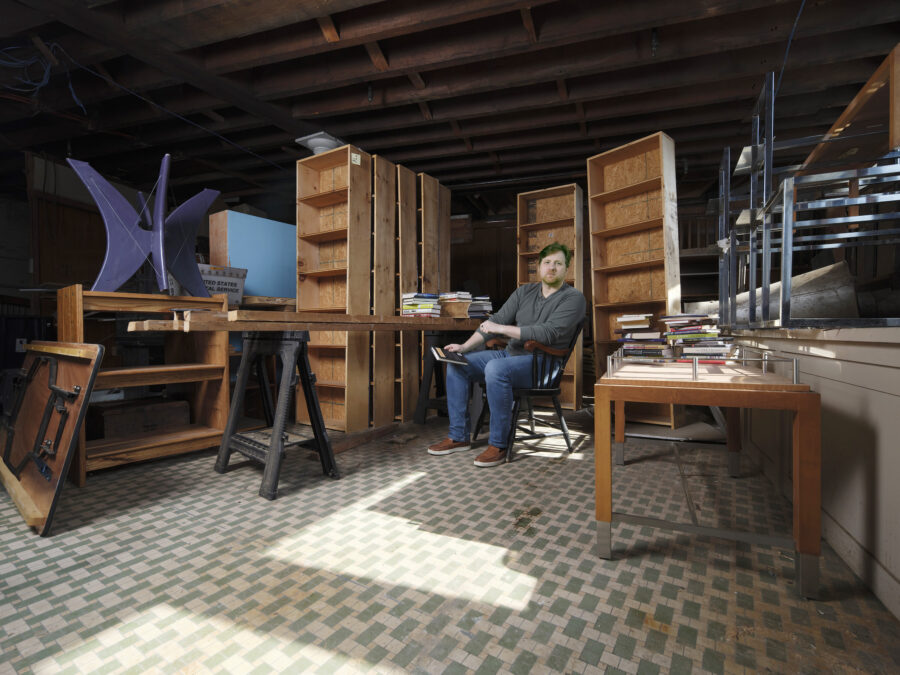
Zachary Bos
Zachary Bos, Bookseller, Goldfinch Mercantile and Bonfire Bookshop . Photographed April 10, 2024.
“This is Zak, who read the books.”
That is how Zak was introduced by his 5th-grade teacher to one of her colleagues. Coming from a home of modest income in Patterson, NJ, Zak hungrily latched onto whatever resources he could, including reading the entire World Book Encyclopedia. Twice. Today, Zachary Bos is opening two bookstores in downtown Fitchburg: Goldfinch Mercantile, a retail shop offering new titles and the second, Bonfire bookshop, a combination retail-office space, offering used and antiquarian books. The latter will include amenities for visiting readers: a coffee bar, soft music, and patio seating. “This will be a relaxing retail destination.”
Zak’s world is indeed comprised of words and ideas—just listen to him speak; his language is eloquent, and he expresses himself in paragraphs—but his dreams are also empowered with agency. “I’ve always been a writer,” he says, seated among shelves and inventory in a temporary warehouse. “I never thought of it as a career path because it didn’t feel like the responsible thing to do.” So, he created a path for himself, not just for his success but to uplift others. “I engage to catalyze, uplift, and multiply. If I help 10 people increase the success of their work by 10%, that’s 100 percent.” He still does this, and now he also has his own publishing company, Pen and Anvil Press. Without capital to launch his bookstore project, he had to “ask people for the money. I brought people in on the train. I put them up for a week or a weekend. I showed them the bright windows and the dark windows.” He shared his vision. They saw the opportunity. “Fitchburg is poised for growth.”
Historically, Fitchburg was, and will be again, a regional center for culture and the arts. His bookstores will be part of that. “Why are we funding the arts? We need jobs. The arts build stories, and stories build hope. Hope brings investment. Investments bring jobs.” Zak wants to provide bookstores “where everyone in the community can find their stories. I am not a hobbyist trying to turn it into a profession. This is a business. I want to provide a livelihood for myself and three or four people involved with the business.”
“Public perception, even self-perception, of Fitchburg must change. Most residents take well-deserved pride in the city’s history, and too many outsiders conjure economic downturn at first mention of the city’s name. These perspectives are rooted in the past. The stories cling to the teller. That narrative space is dominated by people who say, ‘I remember when …’ But artists look to the future and aren’t bounded by limited imagination. They push through cynicism. They’re undaunted.”
With two bookstores about to open, Zachary Bos undauntedly participates in the creative economy poised to surge through Fitchburg.
Zachary Bos
Zachary Bos, librero, Goldfinch Mercantile y Bonfire Bookshop. Fotografiado el 10 de abril de 2024.
«Este es Zak, el que lee los libros».
Así fue como la maestra de quinto grado de Zak lo presentó a una de sus colegas. Proveniente de un hogar de recursos modestos en Paterson, Nueva Jersey, Zak se aferró con avidez a cualquier recurso a su alcance, lo que incluyó leer completa la enciclopedia World Book. Dos veces. Hoy, Zachary Bos está abriendo dos librerías en el centro de Fitchburg: Goldfinch Mercantile, una tienda minorista que ofrece títulos nuevos, y una segunda, Bonfire Bookshop, un espacio híbrido de oficinas y comercio minorista dedicado a libros usados y de colección. Esta última incluirá comodidades para los lectores visitantes: una barra de café, música suave y mesas en el patio. «Será un destino comercial relajante».
El mundo de Zak está ciertamente compuesto de palabras e ideas —basta escucharlo hablar; su lenguaje es elocuente y se expresa en párrafos completos—, pero sus sueños también están impulsados por la determinación y la iniciativa. «Siempre he sido escritor», dice, sentado entre estanterías e inventario en un almacén provisional. «Nunca lo consideré como un plan de carrera profesional porque no me parecía lo más responsable». Así que trazó su propio camino, no solo en busca de su propio éxito, sino para impulsar a los demás. «Me involucro para dinamizar, apoyar y multiplicar. Si ayudo a 10 personas a incrementar el éxito de su trabajo en un 10%, eso suma un 100 por ciento». Todavía lo hace, y ahora también cuenta con su propia editorial, Pen and Anvil Press. Sin capital suficiente para poner en marcha el proyecto de sus librerías, tuvo que «pedir dinero a la gente. Traje personas en tren. Las hospedé durante una semana o un fin de semana. Les mostré los escaparates luminosos y los oscuros». Compartió su visión. Vieron la oportunidad. «Fitchburg está preparada para crecer».
Históricamente, Fitchburg fue, y volverá a ser, un referente regional para la cultura y las artes. Sus librerías formarán parte de ese proceso. «¿Por qué financiamos las artes? Necesitamos empleos. Las artes construyen historias, y las historias generan esperanza. La esperanza atrae inversiones. Las inversiones generan empleos». Zak quiere ofrecer librerías «donde todos en la comunidad puedan encontrar sus historias. No soy un aficionado tratando de convertir esto en una profesión. Esto es un negocio. Quiero asegurar el sustento para mí y para tres o cuatro personas involucradas en el proyecto».
«La percepción pública de Fitchburg, e incluso la autopercepción de sus habitantes, debe cambiar. La mayoría de los residentes sienten un merecido orgullo por la historia de la ciudad, mientras que demasiadas personas de fuera evocan el declive económico en cuanto escuchan el nombre de la ciudad. Esas perspectivas están ancladas en el pasado. Las historias se quedan pegadas a quien las cuenta. Ese espacio narrativo está dominado por quienes dicen: “Me acuerdo cuando…”. Pero los artistas miran hacia el futuro y no están atados por una imaginación limitada. Van más allá del cinismo. Son inquebrantables».
Con dos librerías a punto de abrir, Zachary Bos participa con determinación inquebrantable en la economía creativa que está lista para florecer en Fitchburg.
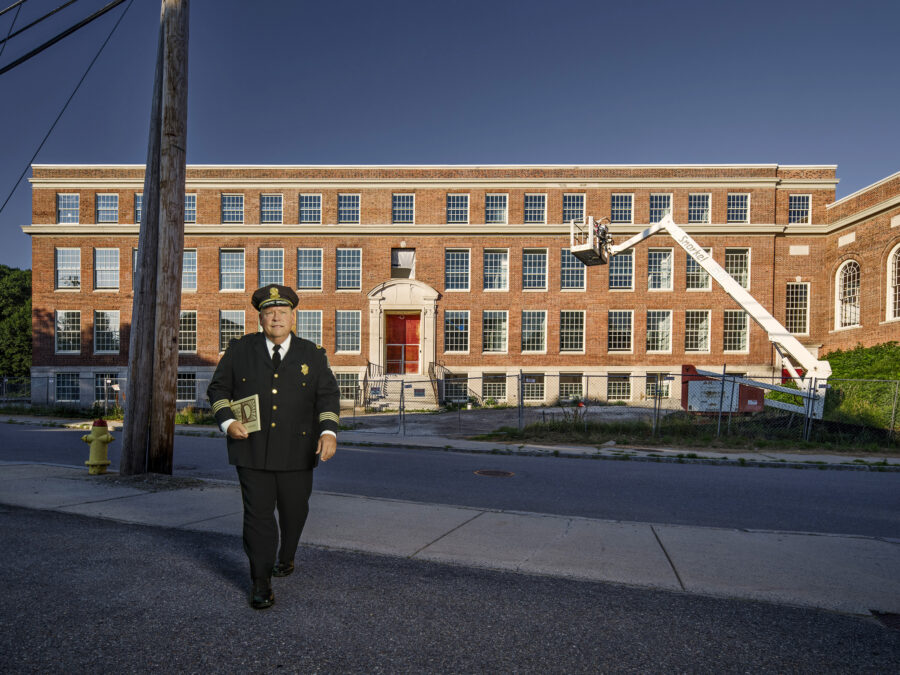
Chief Ernest Martineau
Police Chief Ernest Martineau, Retired, carries his middle school yearbook at BF Brown, now Fitchburg Arts Community. Photographed July 2, 2024.
“I’m going to be just like you someday.”
Police Chief Ernest Martineau lived on Elm Street, less than 1/8th mile from BF Brown Junior High School. “In the 70s, your neighborhood was everything. Back in those days, you knew everyone who lived around you. At 7:00 at night, you could hear everybody’s mother yelling from the porch, ‘Time to come home!’ My mother was a single parent raising two kids. She had two jobs. We started off on the 3rd floor of a triple-decker apartment building on 399 Elm Street. As tenants changed, we moved down a floor so my mother wouldn’t have to carry groceries up the stairs. When we finally made it to the first floor, it was like we hit the lottery. It was a big deal.”
In 1979, Ernest Martineau was a ninth grader at BF Brown. “That school is truly near and dear to me. I was Captain of the football team and Student Council President. I was actively involved in putting our school dances together, and we would hire a police officer to chaperone. At one particular dance, I became enthralled with policing and spent most of the night talking to Officer Peter Roddy, the police officer hired for the event, and not participating much in the dance. ‘I’m going to be just like you someday,’ I told him.” Sure enough, Ernest Martineau became a policeman upon graduation from college and rose to the rank of Fitchburg Police Chief in 2015.
“I’ve had to make some tough decisions over the years, but if you stay focused on your mission, it’s not that difficult. You can bring a compassionate side to police work. I refer to the three T’s of policing. It begins with Trust. Having trust in the community. The second is Transparency. Transparency allows the community to trust the police. And third is Teamwork. The police and the community have to work together.”
There was civil unrest throughout the country after the George Floyd incident in Minnesota. “We had three to five thousand people demonstrating on Main Street. We were one of the very few demonstrations in the State that had zero disruptions. The demonstration went without a hitch. Everybody respected each other’s space. It was actually a wonderful day where people had an opportunity to express how they felt. We were there to make sure that they felt safe, that we felt safe, and that there were no disruptions. That said a lot about our community on that day.”
Back in the day on Elm Street, “We didn’t have a lot of money, but we had a sense of ownership in our community. I’ve seen a lot of transformation in the city over the past several years. One of the biggest is where we started creating homeownership opportunities in the neighborhood. That needs to continue.” “And now, with the conversion of BF Brown into affordable housing for artists, there are going to be dozens of apartments supporting the regional arts community. I can’t think of a better use of my old school building. It is extraordinary.”
Jefe de policía Ernest Martineau
El jefe de policía Ernest Martineau, jubilado, lleva su anuario de la escuela secundaria en BF Brown, ahora Fitchburg Arts Community. Fotografiado el 2 de julio de 2024.
«Algún día voy a ser como usted».
El jefe de policía Ernest Martineau vivía en Elm Street, a menos de un octavo de milla (unos 200 metros) de la escuela secundaria BF Brown. «En los años 70, tu vecindario lo era todo. En aquella época, conocías a todos los que vivían a tu alrededor. A las siete de la tarde se podía escuchar a las madres de todos gritando desde el porche: “¡Hora de volver a casa!”. Mi madre era una madre soltera criando a dos hijos. Tenía dos empleos. Empezamos en el tercer piso de un edificio de apartamentos tipo triple-decker en el 399 de Elm Street. A medida que cambiaban los inquilinos, nos mudábamos un piso más abajo para que mi madre no tuviera que subir las bolsas de la compra por las escaleras. Cuando finalmente llegamos al primer piso, fue como si nos hubiéramos ganado la lotería. Fue un gran acontecimiento».
En 1979, Ernest Martineau cursaba el noveno grado en BF Brown. «Esa escuela es verdaderamente entrañable para mí. Fui capitán del equipo de fútbol americano y presidente del consejo estudiantil. Participaba activamente en la organización de los bailes escolares, para los cuales contratábamos a un agente de policía como acompañante y supervisor. En un baile en particular, la labor policial me fascinó por completo; pasé casi toda la noche conversando con el agente Peter Roddy, el policía contratado para el evento, sin participar mucho en el baile. “Algún día voy a ser como usted”, le dije». Y así fue: Ernest Martineau se incorporó a la policía al graduarse de la universidad y ascendió hasta convertirse en jefe de la policía de Fitchburg en 2015.
«He tenido que tomar decisiones difíciles a lo largo de los años, pero si te mantienes enfocado en tu misión, no resulta tan complicado. Se puede aportar un lado compasivo al trabajo policial. Yo me refiero a las tres “C” del servicio policial: la primera es la Confianza, tener confianza en la comunidad; la segunda es la Claridad o transparencia, que permite a la comunidad confiar en la policía; y la tercera es la Colaboración en equipo, donde la policía y la comunidad deben trabajar juntas».
Tras el suceso de George Floyd en Minnesota, hubo disturbios sociales en todo el país. «Tuvimos entre tres mil y cinco mil personas manifestándose en Main Street. Fuimos una de las contadísimas manifestaciones en todo el estado que no registró ningún altercado. La marcha transcurrió sin contratiempos. Todos respetaron el espacio de los demás. En realidad, fue un día maravilloso en el que la gente tuvo la oportunidad de expresar lo que sentía. Estábamos allí para asegurarnos de que ellos se sintieran seguros, de que nosotros nos sintiéramos seguros y de que no hubiera disturbios. Eso dijo mucho sobre nuestra comunidad en aquel día».
En aquellos tiempos en Elm Street, «no teníamos mucho dinero, pero teníamos un sentido de pertenencia a nuestra comunidad. He presenciado una gran transformación en la ciudad durante los últimos años. Uno de los mayores logros ha sido empezar a generar oportunidades para ser propietario de una vivienda en el vecindario. Eso debe continuar». «Y ahora, con la transformación de BF Brown en viviendas asequibles para artistas, habrá decenas de apartamentos que respaldarán a la comunidad artística regional. No se me ocurre un mejor uso para el edificio de mi antigua escuela. Es extraordinario».
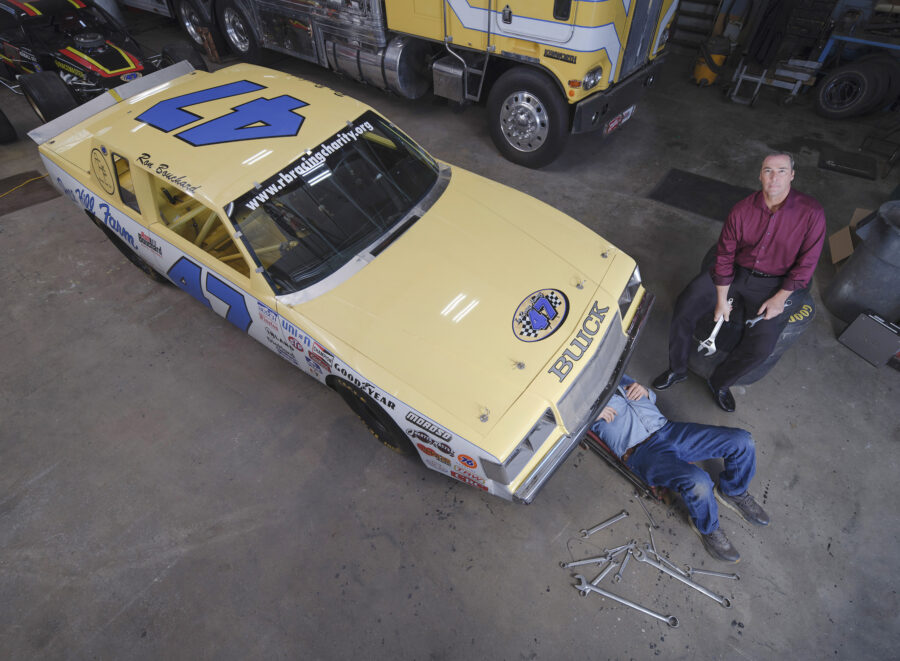
Jim Desrosiers
Jim Desrosiers Lends a Hand at the Ron Bouchard Racing Museum. Photographed November 5, 2024.
At age 14, Ron Bouchard, later dubbed “The Kid from Fitchburg,” stepped in as a last-minute substitute driver for his father’s race car at Brookline Speedway. Too young for a driver’s license, The Kid won. His career accelerated rapidly: five consecutive championships at Seekonk Speedway (1967–1971) and, in 1981, a historic upset victory by a hair in a three-car photo finish at the Talladega 500, clinching NASCAR’s Rookie of the Year.
Ron was a champion who cared deeply about his impact. After races, he posed with young fans and often gifted his trophies to the kids who cheered him on. Jim Desrosiers was one of those kids. Growing up amid poverty and family trauma, Jim saw the racing star as a beacon of possibility. “If he’s from Fitchburg and can succeed, maybe I can, too.” Though stability arrived later through a supportive stepfather and military service, Ron had kept Jim’s childhood hope alive when he needed it most.
Years later, while serving as Director of Development at the Fitchburg Art Museum, Jim finally met Bouchard. The two formed a lasting friendship, with Ron mentoring Jim, and together they collaborated to raise funds for local nonprofits. Jim subsequently founded GROWTHco, an executive coaching and leadership consultancy dedicated to helping individuals and organizations realize their full potential.
After Ron’s death in 2015 from cancer, Jim recognized that legacy is the vehicle that passes values across generations. Working alongside the Bouchard family, Jim helped establish the RB Racing Charity to support families facing cancer and fund positive youth programs.
Jim also spearheaded a bronze memorial depicting The Kid from Fitchburg mentoring a young boy. It stands in Fitchburg’s Coolidge Park. Vulnerable children may see themselves as that child, and we adults should see ourselves as Ron Bouchard.
Jim Desrosiers
Jim Desrosiers echa una mano en el Museo de Carreras Ron Bouchard. Fotografiado el 5 de noviembre de 2024.
A los 14 años, Ron Bouchard, más tarde conocido como «El Chico de Fitchburg» (The Kid from Fitchburg), sustituyó a última hora al piloto del auto de carreras de su padre en el autódromo Brookline Speedway. Demasiado joven para tener una licencia de conducir, El Chico ganó la carrera. Su carrera profesional se aceleró rápidamente a partir de ahí: obtuvo cinco campeonatos consecutivos entre 1967 y 1971 en el Seekonk Speedway y, en 1981, logró una histórica e inesperada victoria por un margen milimétrico en un final fotográfico de tres autos en la Talladega 500, consagrándose como Novato del Año de NASCAR.
Ron fue un campeón profundamente consciente de su impacto. Después de las carreras, posaba con los jóvenes fanáticos y a menudo regalaba sus trofeos a los niños que lo aclamaban. Jim Desrosiers fue uno de esos niños. Al crecer entre la pobreza y el trauma familiar, Jim vio a la estrella del automovilismo como un faro de posibilidad. «Si él es de Fitchburg y puede triunfar, tal vez yo también pueda». Aunque la estabilidad llegó más tarde gracias a un padrastro comprensivo y al servicio militar, Ron mantuvo viva la esperanza infantil de Jim cuando más la necesitaba.
Años después, mientras se desempeñaba como Director de Desarrollo en el Museo de Arte de Fitchburg, Jim conoció finalmente a Bouchard. Ambos forjaron una amistad duradera; Ron se convirtió en el mentor de Jim y juntos colaboraron para recaudar fondos en beneficio de organizaciones sin fines de lucro locales. Posteriormente, Jim fundó GROWTHco, una consultoría de liderazgo y capacitación ejecutiva dedicada a ayudar a personas y organizaciones a alcanzar su máximo potencial.
Tras el fallecimiento de Ron en 2015 a causa del cáncer, Jim comprendió que el legado es el vehículo que transmite valores de una generación a otra. Trabajando junto a la familia Bouchard, Jim ayudó a establecer la organización benéfica RB Racing Charity para apoyar a familias que enfrentan el cáncer y financiar programas positivos para la juventud. Jim también impulsó la creación de un monumento de bronce que representa a El Chico de Fitchburg como mentor de un niño. La obra se encuentra en el parque Coolidge de Fitchburg. Los niños vulnerables pueden verse reflejados en ese pequeño, y nosotros, los adultos, deberíamos vernos reflejados en Ron Bouchard.
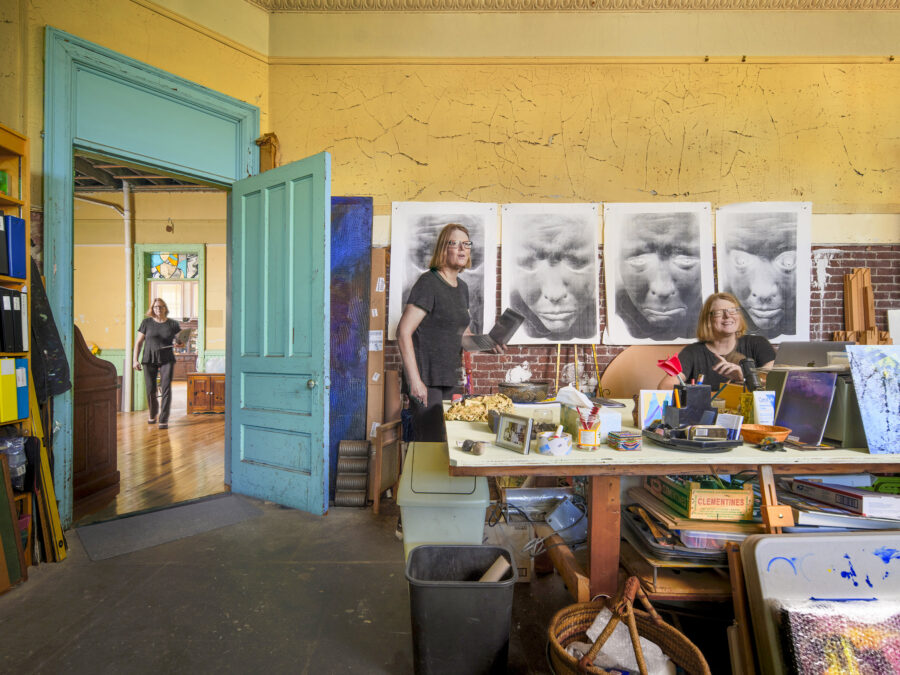
C.M. Judge
Time-based artist C.M. Judge in her studio. Photographed September 16, 2024.
Artist C.M. Judge and her husband, John Heimo, live and work in an 1889 schoolhouse. Perched on a hill overlooking former mills along the North Nashua River, the West Fitchburg Grammar School still carries echoes of the past and the memories of the students who once filled it. These include girls jumping rope and playing hopscotch, boys playing rag ball between buildings, and less cheerful memories of a teacher who disciplined students by grabbing their ears.
“The generosity of sharing information doesn’t necessarily match the generosity of spirit,” C.M. reflects during a conversation about art, teachers, and creative intent. It is fitting that C.M. and John—both former teachers with far more generous perspectives—now call the schoolhouse home. After purchasing the building in 1997, they restored it and converted one of its spacious rooms into C.M.’s studio.
C.M. is an internationally recognized artist who has exhibited across France, Germany, Uruguay, the Netherlands, Japan, and the United States. Holding a Master of Science in Advanced Visual Studies from MIT, she describes herself as an intermedia artist: “I work with 2D, 3D, and time-based media. My works do not arise from the medium; they evolve through ideation.” Rather than confining herself to a single discipline, she selects whichever form best serves her concepts and uses imagination and collaboration to reach people’s hearts and minds.
C.M. smiles as she tells me a story about when she first arrived in Fitchburg. “A package from my collaborator in Japan was delivered to my house. I didn’t think anything of it. At 5:00, the mail carrier knocked on my door and said: Did you get your package from Japan? I’m on my way home and just wanted to make sure you received it.” That is the world she lives in. Not all our social interactions may be kind, but kindness prevails when permeated with C.M. Judge’s generous spirit.
C.M. Judge
La artista de medios basados en el tiempo (time-based art) C.M. Judge en su estudio. Fotografiada el 16 de septiembre de 2024.
La artista C.M. Judge y su esposo, John Heimo, viven y trabajan en una escuela de 1889. Encaramada en una colina con vistas a las antiguas fábricas a lo largo del río North Nashua, la escuela West Fitchburg Grammar School todavía conserva los ecos del pasado y los recuerdos de los estudiantes que alguna vez la llenaron. Estos incluyen niñas saltando la cuerda y jugando al tejo (hopscotch), niños jugando a la pelota de trapo (rag ball) entre los edificios, y recuerdos menos alegres de un maestro que disciplinaba a los estudiantes tirándoles de las orejas.
«La generosidad de compartir información no coincide necesariamente con la generosidad de espíritu», reflexiona C.M. durante una conversación sobre el arte, los maestros y la intención creativa. Resulta muy apropiado que C.M. y John —ambos antiguos profesores con perspectivas mucho más generosas— ahora llamen hogar a esta escuela. Tras comprar el edificio en 1997, lo restauraron y convirtieron una de sus amplias salas en el estudio de C.M.
C.M. es una artista de reconocimiento internacional que ha expuesto en Francia, Alemania, Uruguay, los Países Bajos, Japón y los Estados Unidos. Con una Maestría en Ciencias en Estudios Visuales Avanzados del MIT, se describe a sí misma como una artista intermedia: «Trabajo con medios 2D, 3D y basados en el tiempo. Mis obras no surgen del medio; evolucionan a través de la ideación». En lugar de limitarse a una sola disciplina, selecciona la forma que mejor se adapte a sus conceptos y utiliza la imaginación y la colaboración para llegar a los corazones y las mentes de las personas.
C.M. sonríe mientras me cuenta una historia de cuando recién llegó a Fitchburg: «Llegó un paquete a mi casa de parte de mi colaboradora en Japón. No le di mayor importancia. A las 5:00, el cartero llamó a mi puerta y dijo: “¿Recibió su paquete de Japón? Voy camino a casa y solo quería asegurarme de que lo hubiera recibido”». Ese es el mundo en el que vive. Puede que no todas nuestras interacciones sociales sean amables, pero la amabilidad prevalece cuando está impregnada del espíritu generoso de C.M. Judge.

Nate Glenny
A camera on the cameraman: Nate Glenny at FATV. Photographed May 14, 2024.
“All the experience I’ve acquired as a professional, I’m bringing back to the place of my foundation.”
Nate Glenny was just a fifth grader when a Student of the Month award earned him a tour of Fitchburg Access TV (FATV). “The medium, the technology, and the power to speak to so many people in their living rooms was overwhelming,” he recalls. From that day on, his trajectory was set. Starting as a volunteer runner, he worked his way up to cable-puller and camera operator before building a professional career broadcasting for virtually every major network and sports team in New England.
Then, he raised the stakes. Already serving on the Board of Directors, Nate assumed the Directorship of FATV. Shifting from doer to leader, he guided the construction of a state-of-the-art production facility equipped with modern video and podcast studios, top-tier gear, and editing software.
“We are Fitchburg’s greatest cheerleaders,” Nate says. Alongside public meetings, graduations, and popular local sports, FATV’s core focus is community-generated content. For a $40 annual membership fee, anyone living or working in Fitchburg gains full access to studio equipment, Adobe software, hands-on training, and broadcast airtime to produce positive, non-profit programming. Shows air on FATV’s cable channel and stream across Apple, Amazon, and Spotify—entirely free from algorithmic control.
As one of Massachusetts’s most active and professional community stations, FATV operates with a dedicated team of full-time, part-time, and volunteer staff. Yet staff output is not the primary measure of success. “Our core function is to engage and empower our community, and to teach members how to use our equipment,” Nate emphasizes.FATV does not aspire to speak for the community; it aspires to be the medium through which the community speaks for itself.
Nate Glenny
Una cámara sobre el camarógrafo: Nate Glenny en FATV. Fotografiado el 14 de mayo de 2024.
«Toda la experiencia que he adquirido como profesional la estoy trayendo de vuelta al lugar de mis cimientos».
Nate Glenny era apenas un estudiante de quinto grado cuando un premio al Estudiante del Mes le valió una visita a Fitchburg Access TV (FATV). «El medio, la tecnología y el poder de hablarle a tantas personas en sus salas de estar fue algo sobrecogedor», recuerda. A partir de ese momento, su trayectoria quedó trazada. Comenzando como mandadero voluntario (runner), fue ascendiendo a asistente de cableado (cable-puller) y operador de cámara antes de forjarse una carrera profesional transmitiendo para prácticamente todas las cadenas principales y equipos deportivos de Nueva Inglaterra.
Luego, redobló la apuesta. Siendo ya miembro de la Junta Directiva, Nate asumió la dirección ejecutiva de FATV. Al pasar de ser un ejecutor a un líder, guio la construcción de una moderna instalación de producción de última generación, equipada con estudios de video y podcast, equipos de primer nivel y software de edición.
«Somos los mayores impulsores y promotores de Fitchburg», afirma Nate. Junto con las reuniones públicas, las graduaciones y los populares deportes locales, el enfoque central de FATV es el contenido generado por la comunidad. Por una cuota de membresía anual de $40, cualquier persona que viva o trabaje en Fitchburg obtiene acceso completo al equipo del estudio, al software de Adobe, a capacitaciones prácticas y al tiempo de transmisión en los canales para producir programación comunitaria, positiva y sin fines de lucro. Los programas se transmiten en el canal de cable de FATV y se difunden a través de Apple, Amazon y Spotify, completamente libres de controles algorítmicos.
Como una de las estaciones comunitarias más activas y profesionales de Massachusetts, FATV opera con un dedicado equipo de personal a tiempo completo, tiempo parcial y voluntarios. Sin embargo, el volumen producido por el personal no es la medida principal de su éxito. «Nuestra función esencial es involucrar y empoderar a nuestra comunidad, y enseñar a los miembros cómo usar nuestros equipos», enfatiza Nate.
FATV no aspira a hablar por la comunidad; aspira a ser el medio a través del cual la comunidad habla por sí misma.
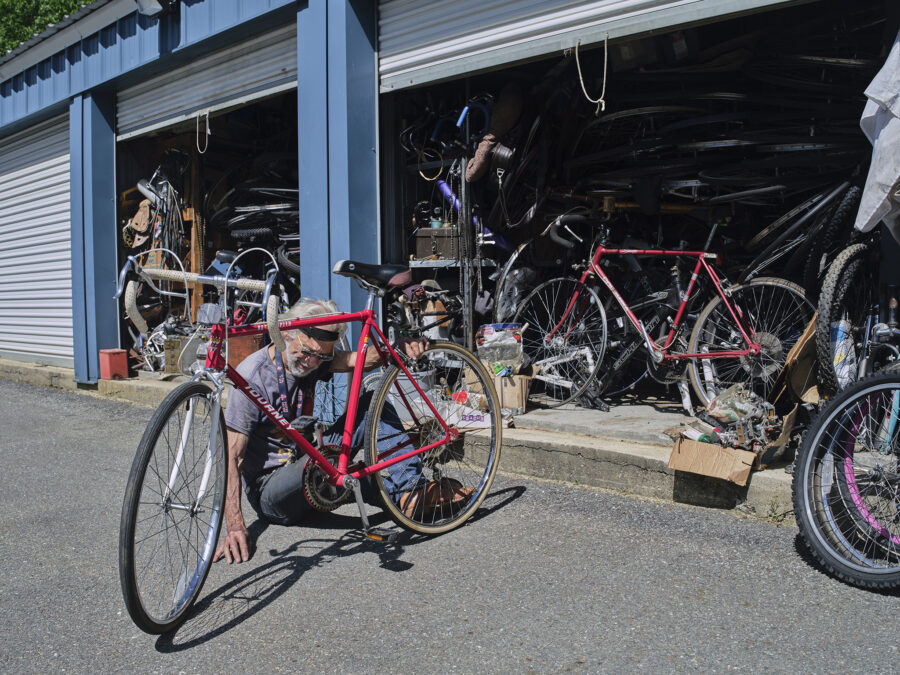
Barry Slome
Barry Slome fixes bicycles somewhere in Fitchburg. Photographed May 25, 2024.
Somewhere on a side street in Fitchburg, you may find a man seated on the ground, fixing a bicycle. Not one, but many. Stop to talk with him, and you will find someone at peace with himself and clear in his purpose. The conversation will be simple, grounded, and sufficient unto itself.
Barry Slome breathes life into broken and derelict bicycles. “It keeps my hands occupied,” he says. “It’s not that I love to fix bicycles. It can be very frustrating. It’s dirty, my hands get filthy… and they’re not always easy to repair.” He keeps a very low profile. No advertising, no social media, and a private address. Yet he and his passion are widely known. He prefers vintage bikes from the 1970s and ’80s over the modern ones. “They were simpler.” For Barry, simplicity goes hand in hand with clarity.
Barry’s roots in Fitchburg run generations deep. As a boy attending B.F. Brown Junior High School, cycling meant discovery. “My first bike was a 20-inch Columbia. Later, my father bought me an English bike, a Dunelt… At 10, I rode that bike from my house to Cleghorn… That’s all the way across town! It was a real trip, an adventure.”
Today, he restores bicycles for the occasional visitor. “I don’t care if it is a cheap or expensive bike. They’re all nice to ride. If it is a nonworking ten-speed, I’ll take one of the chainrings off a rail and turn it into a five-speed. That’s all you really need.”
Barry never sought a conventional career, and his work remains a labor of love that merely covers storage expenses. “I like the simplicity of things,” he reflects. “I hate to see a bike scrapped, even a low-end bike. You know it’s useful to someone. Or it could be.”
Barry Slome
Barry Slome repara bicicletas en algún lugar de Fitchburg. Fotografiado el 25 de mayo de 2024.
En algún lugar de una calle secundaria de Fitchburg, es posible encontrar a un hombre sentado en el suelo, reparando una bicicleta. No una, sino muchas. Si te detienes a hablar con él, encontrarás a alguien en paz consigo mismo y con un propósito claro. La conversación será sencilla, centrada y suficiente en sí misma.
Barry Slome devuelve la vida a bicicletas rotas y abandonadas. «Mantiene mis manos ocupadas», afirma. «No es que me encante arreglar bicicletas. Puede ser muy frustrante. Es sucio, se me ensucian las manos… y no siempre son fáciles de reparar». Mantiene un perfil muy bajo: sin publicidad, sin redes sociales y con una dirección privada. Aun así, él y su pasión son ampliamente conocidos. Prefiere las bicicletas clásicas de los años 70 y 80 frente a las modernas. «Eran más simples». Para Barry, la sencillez va de la mano de la claridad.
Las raíces de Barry en Fitchburg se remontan a varias generaciones. De niño, cuando asistía a la escuela secundaria B.F. Brown Junior High School, el ciclismo significaba descubrir. «Mi primera bicicleta fue una Columbia de 20 pulgadas. Más tarde, mi padre me compró una bicicleta inglesa, una Dunelt… A los 10 años, fui en esa bicicleta desde mi casa hasta Cleghorn… ¡Eso es al otro lado del pueblo! Fue un verdadero viaje, una aventura».
Hoy en día, restaura bicicletas para algún visitante ocasional. «No me importa si es una bicicleta barata o cara. Todas son agradables de manejar. Si es una de diez velocidades que no funciona, le quito uno de los platos y la convierto en una de cinco velocidades. Eso es todo lo que realmente se necesita».
Barry nunca buscó una carrera convencional, y su trabajo sigue siendo una labor por puro amor al arte que apenas cubre los gastos del depósito donde las guarda. «Me gusta la simplicidad de las cosas», reflexiona. «Detesto ver una bicicleta desechada, incluso una de gama baja. Uno sabe que le sirve a alguien. O que podría servirle».
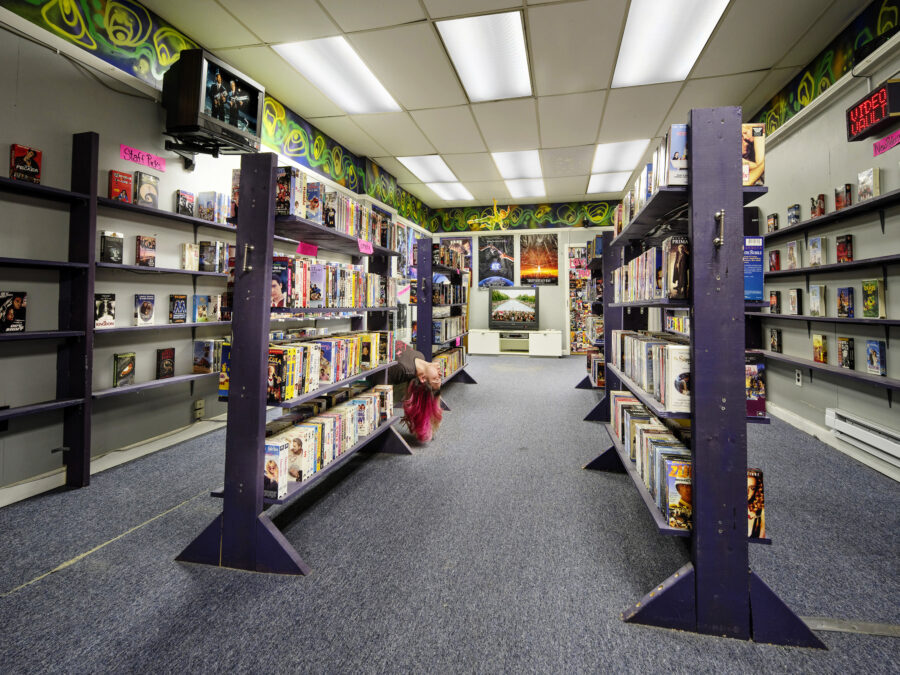
Audrey Pendleton-Chow
Director, Curious Escape Rooms
Audrey Pendleton-Chow can’t help but get involved. Her enthusiasm just won’t be suppressed. Mostly out of curiosity, she attended a public input meeting presented by the Fitchburg Cultural Council in 2017. It was not a large meeting. Seeing a new face, Council members asked how they might get more people involved with them and Arts & Culture in the community. “Start a Facebook Group,” Audrey suggested. “We don’t know much about that,” Council members replied. “I can start one for you!” Audrey heard herself say. She has since become the Council’s Chair.
“Sometimes you have a vague idea of the goal,” Audrey says, surrounded by VHS tapes. “You’re not sure what the goal is going to look like, you’re not sure how you’re going to accomplish it, and there will be different puzzles you have to solve along the way.” Here, she is not speaking of her work for the Council. She speaks of the challenges in escape rooms, like her interactive art installation – a fake video store.
Curious Escape Rooms, a unique venture started by Audrey and her husband, Jeremy, in 2016, offers immersive game experiences that transport you to worlds that invoke a sense of nostalgia and wonder. The 90’s Video Store is one such creation. (Curious Escape Rooms offers other games and variant scenarios under the same roof.). Players come from Boston, Rhode Island, New Hampshire, Vermont, and Eastern New York to wrestle with existential riddles in an allotted amount of time.
“You have to find a secret videotape before the boss comes back!” Audrey says, explaining the challenge of her fake video store game scenario. “That’s all you know. You’ve been called, and we need to find it before the boss returns.” The beauty of such a game is its tantalizing ambiguity. Players must play the game to discover its internal logic. In other words, players must play the game to learn the game’s rules. This game is a team sport; people work together to “escape” a looming consequence.
And so it is for creative small businesses such as hers. One must first explore the room to discover unseen constraints, then cobble together a plan circumventing whatever obstacles one encounters. For example, a challenge facing storefronts in Fitchburg’s central business district is the district’s size. The main drag is nearly one mile long. Even with a fair number of businesses operating there, they are spread out, seemingly disconnected, and create an impression that Main Street is barren. Audrey knows it is not.
Audrey is a team player. She voluntarily compiled a spreadsheet of downtown businesses so each could keep others informed of their programs, opportunities, and concerns. Audrey also produced a map identifying each company and its location, promoting retail activity. And she installed a public bulletin board where anyone could post a flyer announcing their event.
Audrey Pendleton-Chow is passionate about solving puzzles. As with her Curious Escape Rooms conundrums, her enthusiasm is infectious and much to the community’s benefit.
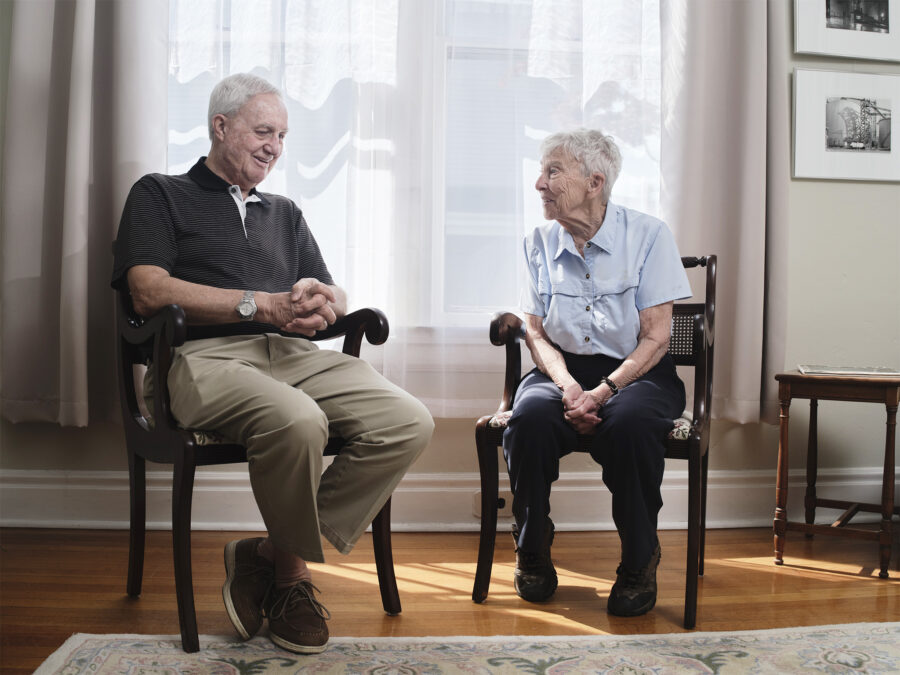
Bill Flynn
Fitchburg Mayor, 1968-1971
Marion Stoddart
Founder, Nashua River Watershed Association
Bill Flynn was fascinated by the first-ever broadcast of the Democratic National Convention as a young boy. Civic service called him. He ran for and won a Fitchburg City Council seat at 22. “But the Council wasn’t focusing on the big issues,” he says, so Bill ran for Mayor at 25. Fitchburg was grappling with poor governance, a lack of regional engagement, and experiencing a severe drought.
A polluted Nashua River running through downtown Fitchburg was the background to all this. The Nashua River in the 60s “was unsuitable to transport waste,” Marion Stoddart says. “If you stood on a bridge and threw in a big rock, it wouldn’t sink. The river ran different colors every day. And it smelled like rotten eggs. It was one of the ten most polluted rivers in the United States.”
Marion Stoddart, then a young mother of three, had arrived in nearby Groton in 1962. The Nashua passed near her home, downriver from Fitchburg. Her move to Groton was an opportunity to reflect on her life. Marion asked herself, “Why am I here? What is it I’m supposed to be doing?” Her answer: committing herself to “taking on the greatest challenge I thought I could accomplish in my lifetime.”
“The most change comes from outsiders,” Bill says, “because when you’re in the thick of it, you don’t see the problems.” Marion appeared at a City Council meeting and spoke of the river’s pollution. Responding to her initiative, the Council funded a restoration feasibility study. Following that, Bill continues, “I put all kinds of miles on my car traveling to Boston, wrestling with the bureaucracy. If you didn’t push this thing, it wouldn’t happen.” The two worked tirelessly to pass State legislation, tightening standards for industrial discharge, building grassroots support for the river, and battling misconceptions. (One mill owner reportedly asked its employees, “Would you rather have clean water or your job?”) Bill and Marion subsequently helped persuade the City Council to issue a $27.5 million bond in 1970 to help clean up the river. “That was like twice the existing city debt!” Bill remembers.
“Now, it is a wonderful recreational river. People are canoeing, fishing, and swimming,” Marion says.
“Fitchburg was a national leader in the effort to clean up the environment,” Bill proudly states. “Marion was a champion of the process. Once Fitchburg turned the switches, all the other sins started to show up. Downriver, they couldn’t hide it anymore.” And the Nashua River Watershed Association was an outgrowth of Marion’s efforts.”
“We couldn’t have done this without Bill,” Marion Stoddart says.
“We needed the outsider to inspire us,” Bill Flynn replies.
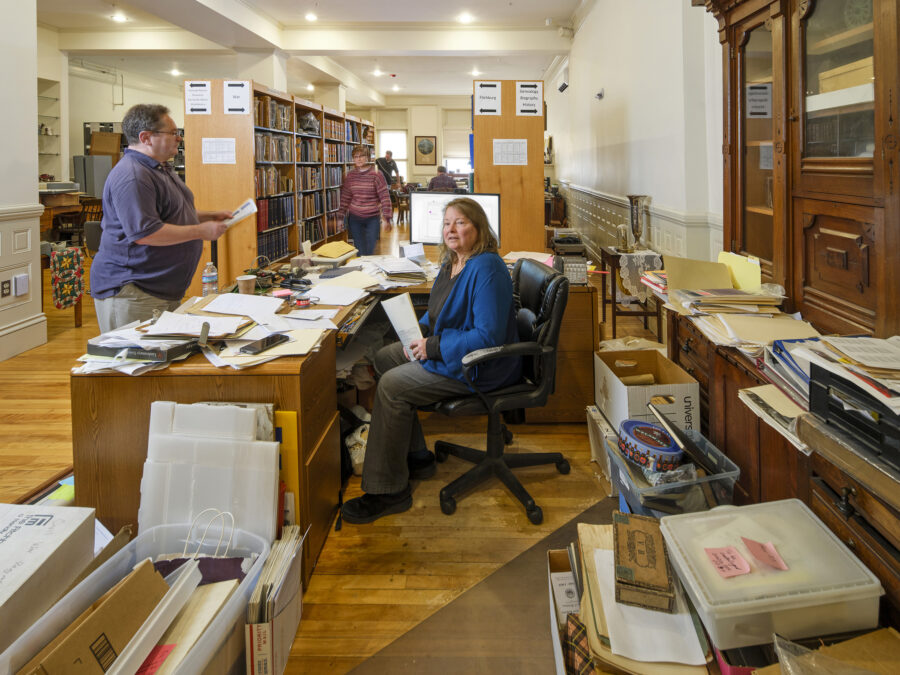
Susan Navarre
Executive Director, Fitchburg Historical Society
People fall in love with history in different ways. It was a Rachmaninoff concert for Susan Navarre, Executive Director of the Fitchburg Historical Society. She was astonished to learn a pianist of his caliber travelled to Fitchburg in 1927 to play in Fitchburg City Hall. “They had Rachmaninoff playing his own work. That’s just extraordinary for a city of 40,000 people, just extraordinary.”
“Fitchburg was the Silicon Valley of the 19th Century,” Susan says. “People were ambitious. We have so many stories of people who started out as factory workers. They saved some money, and then two of them would go off on their own. There’s something exciting about that. When I was younger, that was my understanding of how history should be told. It would be all this fawning on a couple of families that were really wealthy and gave cities all this stuff. But unless it’s your family, that’s not wildly interesting. The story becomes your own when you see something you recognize. Like, this is where I grew up, and this is my grandmother’s.”
Susan realized that nuances could bring history to life. “People often email us, saying: ‘We’re coming to the United States, and we’re going to New York and to Fitchburg.’ They are searching for their histories.” And when they arrive, they place historical facts into a personal context.
“We are not only a history museum.” The Fitchburg Historical Society is an information hub, a repository of artifacts and ideas that help connect individuals within the community. People come here to learn the age of their house, their grandparents’ experiences, the residual implications of discrimination, and who participated in The Underground Railroad. “Knowing history, real history, and telling the truth about history is important to our culture.” And owning a shared history nurtures primal bonds – even among strangers. These bonds are the stuff around which communities coalesce.
The Fitchburg Historical Society’s holdings are vast. “I have been told we have 200,000 discrete items,” Susan says. “More arrive on a weekly basis.” With only one other part-time professional, Loretta Kline, and volunteers, theirs is a labor of love to fulfill information requests. The Fitchburg Historical Society receives as many as 9,000 visitors per year. Susan smiles: “You never know what will be important.”
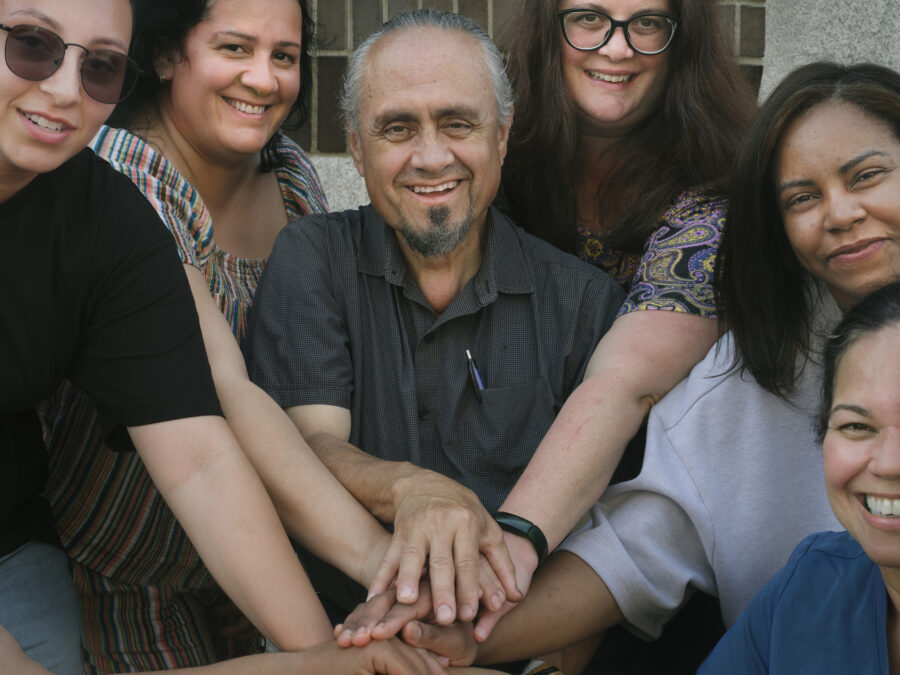
Francisco Ramos
Director of Community Organizing, NewVue Communities
Francisco Ramos, activist and community organizer, experienced political awakening while working with Central American refugees against the backdrop of Contras and revolution. He recalls being stationed in El Salvador in 1988: “Very tough times … and in the middle of a civil war.” It was a trial by fire. “Returning to the States, I recycled myself from issue to issue. Fair and affordable housing, public health, labor rights, tenant rights, you name it.”
There are two throughlines in Francisco’s formative experience. First, he was an advocate for small-voiced people. His role was that of a champion battling for a community’s interests. And second, there was always an adversary. Whether this was a municipal government, a landlord association, or a health insurance company, there was always an opponent from whom he had to wrest concessions. His gain would be their loss.
Skip ahead to 2018, when Francisco joined NewVue Communities, where he is now the Director of Community Organizing. “Traditional organizing is about building power … finding targets and issues,” Francisco says. It is about confrontation. “But here, in Fitchburg, the dynamics are different. Everybody is on the same side. Everyone is working together to revitalize the community. The shared goal is to fuel economic and social progress through housing development, home ownership, small business development, and community organizing.”
Francisco Ramos is realizing this goal with a two-pronged approach: he elicits resident engagement and grooms community leaders. My job, he says, is to “help people grow, develop expertise, and follow their dreams.”
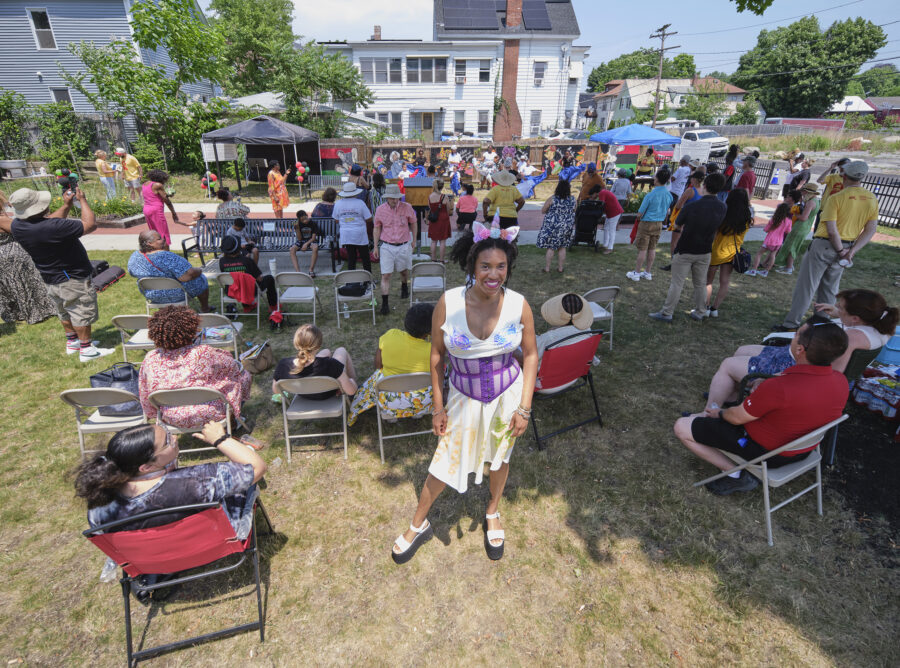
Digi Chivetta
Multi-media Artist
“I moved to Fitchburg from Northborough,” Digi Chivetta tells me. In 2022, she responded to an open call for public art at Fitchburg Abolitionist Park, and the sponsors awarded her a multi-painting project. “My mural depicts a little black girl. She’s crying. A woman wipes tears off her face.” The image is personal. “When I was that girl’s age, I never saw anyone who looked like me in any museum or public art. Anywhere. Ever. So, I wanted kids in this generation to have a different experience. I want kids to know that our community values their presence.
“Once I got that job, I discovered other opportunities here,” she tells me. The Fitchburg Art Museum invited Digi to participate in the Dialogues, Diasporas, and Detours through Africa exhibition, where she presented her fashion work as well as paintings. “I made so much work for that exhibition. They were only able to show about 20 to 30 percent of it. So, after your first museum exhibition, the next thing for your career is to have a solo show. But I couldn’t think of a location that had enough space, and that would let me have a solo show.”
“I am not just an artist; I am also a hustler.” Digi is now creating her own pop-up museum, this one in the form of an art walk through Fitchburg. “I have seven different business locations that will be hosting my work. I’ve custom-designed a gallery space for each. I chose a variety of businesses so that if people are coming from out of town, they can make a whole day out of it. I have a restaurant, a bar, a flower shop, a metaphysical shop, Curious Escape Rooms, Fitchburg Historical Society, and First Parish Church. They’re all on Main Street.”
Digi’s endeavor serves other goals, too. “One of my ideas is to bring more tourism to Fitchburg and more customers to the businesses. And another is to give the people of Fitchburg a place to connect. But beyond that, kids today seem to live such regimented lives. They have so little freedom and little opportunity to socialize with each other outside school and social media. I want to give them something they can do and talk about with each other.”
“It’s not any easier for me than anybody else,” Digi Chivetta says. This artist has ideas, and she is doing something with them.
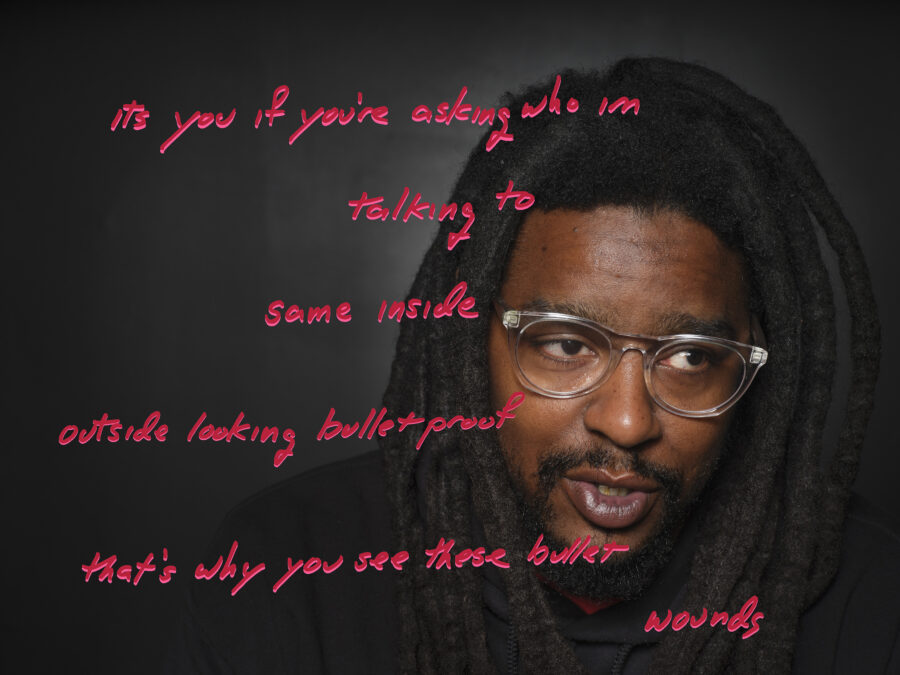
Derek Craig, aka Yo Daddy Doe
Musician and Producer, Young Coff33 Productions
“The darkest part of my life was also the most enlightening. It gave me purpose, which is probably why I am talking to you today.”
Derek Craig discovered his passion as a teenager. That is when he first started to write music. Born in Fitchburg, and a local Massachusetts native throughout, he experienced culture shock attending college in Texas. Everything was unexpectedly comfortable. It was the first time he was not a member of a social minority. He discovered peers and role models. He fell deep into his medium: rap, poetry, and lyrics. In 2019 he opened his own production company, Young Coff33 Productions.
Upon graduation from college, Derek swallowed the bait and entered corporate life. Working for a major lighting company, he traveled up and down the East Coast and into the Midwest. He honed his organizational skills, rising to the position of Project Manager. An unplanned event led him to change course and pursue music and music production full-time. “I’ve grown to understand that managing things creatively is another art form,” he says.
Some people are attracted to Derek because of his music, how he thinks, what he says, or how he says it. Others come because of the platforms he is creating. “We empower other creatives,” Derek tells me. “Our radio, our medium is our music. Without organization, it can’t go anywhere. Our goal is to help creatives understand the business of music.”
“Ricardo, I don’t think you know this,” Derek volunteers. “I am blind. I have no vision in my right eye, and the little in my left is tunnel vision.” Glaucoma robbed Derek of his sight at the age of 27. This is challenging enough, but Derek Craig is also a man of color in a predominantly white society and living in a State where the audience for rap is scattered.
“It is hard to make a living as an artist. I am an Art Steward, a member of Fitchburg’s creative economy, yet I recognize the tokenism I am currently playing, even among my well-meaning friends,” he says. “But I am also a leader of my community, however small. As a minority, sometimes you get stuck in a pigeonhole and can’t say anything because, later on, you might need help from one of the other leaders. You might need one of them in your corner. Minorities are forced to struggle with their own resentment if they want to get anything done.”
“So how do we change the narrative?” Derek asks, then answers his own question. “To begin with, be honest. I try to do that in my music. Say it like it is. Look in the mirror and really see the ecosystem that we live in. Identify the systemic structures shaping – or failing to shape – the opportunities within each niche of our community.”
To which I’ll add: have the courage to raise your flag and rally your peers like Derek Craig.
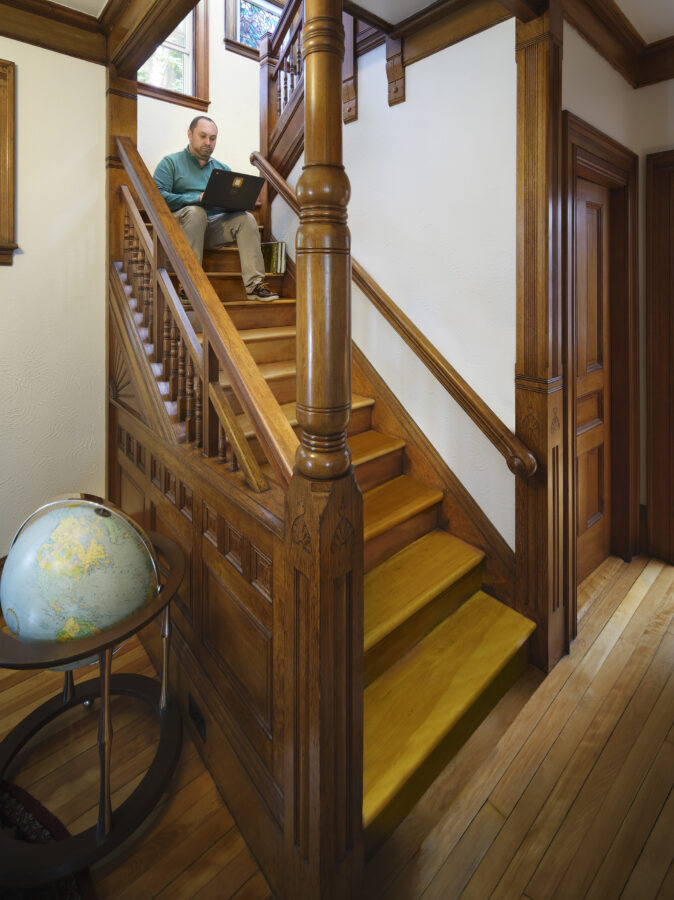
Brendan McWilliams
7th Grade Public School Teacher
Gaetana Montesion arrived in America through Ellis Island in 1914 at age 20. She made her way to Fitchburg, where she met her future husband, Francesco Zichelle. Francesco had immigrated two years earlier, at age 18. While the two had not previously met, they were both from the same hometown, Lacedonia, in southern Italy.
Like all immigrants, the two had high hopes for the future. When World War I interrupted their plans, Francesco enlisted in the US Army Air Service. Upon his return, he found employment as a trolley conductor, then a paper mill employee, and eventually opened a photography studio on Main Street. Gaetana and Francesco were married in 1919. One hundred years later, their great-grandson, a young professional with a graduate degree, lives in a grand Victorian on a hilltop overlooking the city.
An ornate column rises at the foot of the main staircase in this house. It is an exclamation mark emphasizing the intricate relief along its side wall. Hardwood flooring spills from one room into the next. This house was a statement of wealth and taste in Gaetana’s day. Surely, as she passed through Ellis Island, Gaetana hardly dreamed such a house would one day belong to her children and their descendants.
“I bought this house from my grandparents,” Brendan McWilliams tells me. “My grandmother was Gaetana’s daughter. I have fond memories of playing here as a child.” Brendan was born in Fitchburg and attended its public schools. He also fondly remembers a high school teacher, Miss Vuola Bicoules, who continuously challenged him to do better. “She grabbed your attention, so you were fascinated by everything that was happening.”
“I liked school. I thought that if I became a teacher, I would never have to leave it. I got my degrees at Fitchburg State University. I loved it there. Everybody knows you. You’re not a number.” And that attitude is what Brendan brings to his work every day.
“I teach 7th grade in the Fitchburg public school system,” Brendan says. “English Language Arts. It’s about reading and writing. We were pretty heavy on poetry this past year, but we’ve done a lot of short stories and articles on social media and its influencers to decipher what blurs the line between reality and what’s not real.” When the kids write argumentative essays, “I always tell them that if they can make an argument and present the best evidence supporting what they’re saying, then they’re right.”
“Do you have any students you perceive as promising writers,” I ask.
“Oh, yes, most of them. But I also understand that some are late bloomers, and I don’t give up on any of my kids.”
“What gives you the most satisfaction?”
“The look on somebody’s face when they finally get it. Because when they say, ‘Well, I don’t get it.’ I always say you don’t get it yet. ‘Yet’ is the key word. You will. I promise you will.”